Rolex Watch Storage Solutions to Protect Your Investment
Discover essential Rolex watch storage strategies. Learn how to protect your luxury timepiece from theft and damage with safes, winders, and proper insurance.
StolenWatch Team
Watch Authentication Specialist at StolenWatch
Discover essential Rolex watch storage strategies. Learn how to protect your luxury timepiece from theft and damage with safes, winders, and proper insurance.
Protecting your Rolex isn't just about finding a safe spot to stash it. It's a comprehensive strategy for safeguarding a significant investment from theft, environmental damage, and the slow creep of depreciation. A solid plan hinges on a blend of physical security, climate control, and airtight documentation to keep your timepiece's value and integrity intact.
Why Securing Your Rolex Has Never Been More Critical
Once you own a Rolex, the real work begins: protecting it. In today's world, these watches have become a form of "criminal currency," making them a top-tier target for thieves. Simply tucking your prized possession into a drawer or a basic lockbox is asking for trouble. It completely ignores the sophisticated threats that luxury watch owners now face.
The risks are climbing at a frankly terrifying rate. According to The Watch Register, poor storage is a major factor in the $1.3 billion worth of luxury watches reported stolen worldwide. Rolexes aren't just part of that statistic; they dominate it, accounting for a massive 44% of all registered thefts.
The numbers are staggering. Reports of stolen watches jumped by 60% in 2022 and then another 106% the following year. Burglars often target homes because they know that's where watches are kept, and too often, the owners haven't recorded the details needed to even have a chance at recovery. For a deeper dive, it's worth exploring the latest data on luxury watch theft trends.
The Three Pillars of Rolex Protection
A proactive storage plan is your single best defense. Think of it as a three-legged stool—if one leg is weak, the whole thing topples. Your strategy needs to be built on these three core principles working in harmony.
- Rock-Solid Security: We're talking about more than a simple lock. This means choosing a storage solution—like a high-grade home safe or a bank's safe deposit box—that can stand up to a serious, determined thief.
- Climate Control: You might not see it, but humidity and extreme temperatures can wreak havoc on your watch's intricate movement, rubber gaskets, and even the dial. The right storage environment prevents this silent, long-term damage.
- Airtight Documentation: If the worst happens and your watch is stolen, a detailed file with serial numbers, high-resolution photos, and purchase receipts becomes your most critical tool for police reports, insurance claims, and potential recovery.
This guide helps you visualize how to balance security, climate, and documentation when deciding on the best way to store your Rolex.
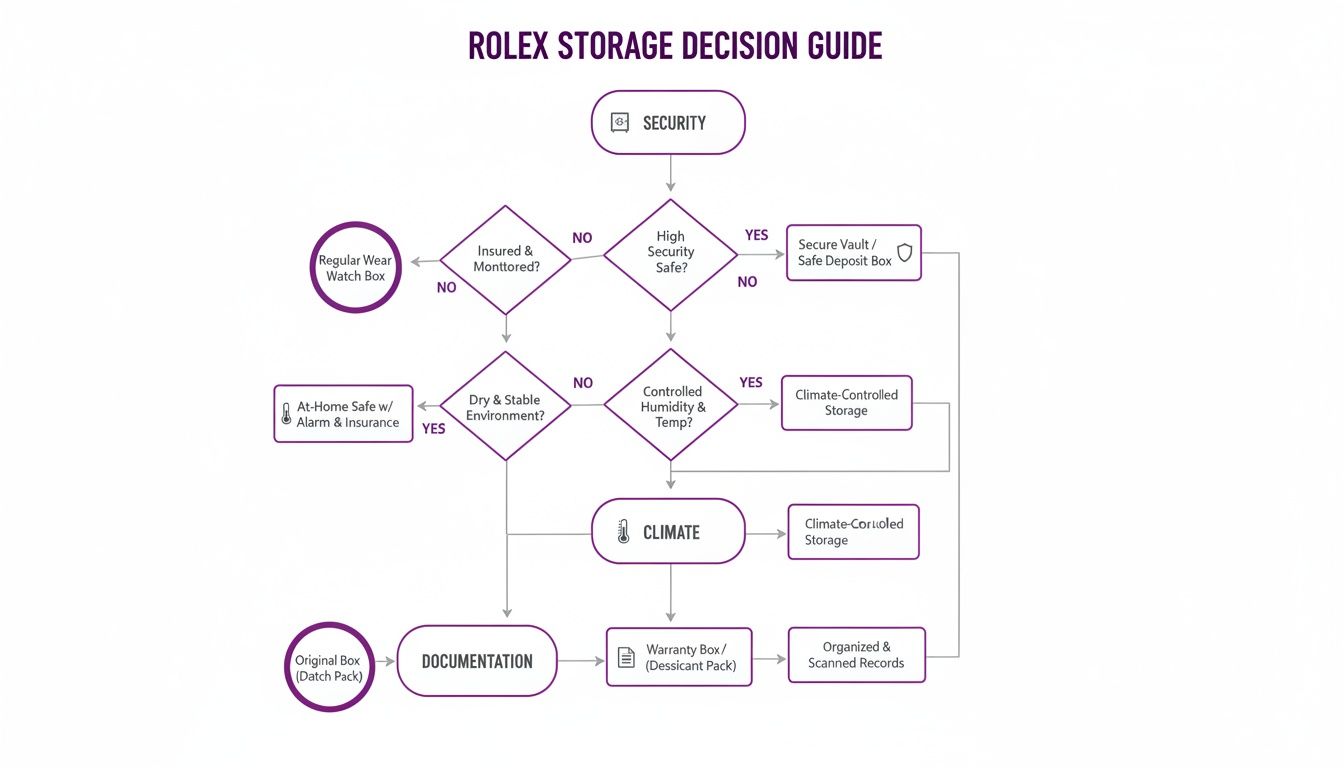 Flowchart outlining the Rolex storage decision guide, covering security, climate, and documentation aspects.
The main point here is that a truly effective strategy doesn't just focus on one of these areas. It weaves all three together.
A common mistake I see is someone spending a fortune on a high-tech safe but then failing to insure the watch or, even worse, keeping the watch's box and papers right next to it. Real security is layered. It has to address the physical threat, the environmental risks, and the crucial paper trail you'll need if things go wrong.
Ultimately, how you store your watch isn't just about stopping a burglar. It’s about preserving its condition, its function, and its history. By taking these elements seriously, you ensure your Rolex remains a valuable and cherished asset for years, or even generations, to come. The next sections will give you practical, actionable steps to put this three-pillar approach into practice.
Securing Your Timepiece at Home
Keeping your Rolex at home is obviously the most convenient option, but it comes with its own set of risks. A lot of people make the mistake of thinking any old lockbox will do the job. The truth is, that standard fireproof box from the office supply store is only built to handle a little heat, not a determined thief with a crowbar. Most of those can be carried right out the door or pried open in a few minutes.
Real security for a luxury watch at home starts with a proper, high-security safe. We're talking about a completely different class of equipment, one engineered from the ground up to stop burglars in their tracks.
What Do High-Security Safe Ratings Actually Mean?
When you start shopping for a real safe, you'll run into a bunch of ratings that can look like alphabet soup. These aren't just marketing buzzwords; they're certifications from independent groups like Underwriters Laboratories (UL) that tell you exactly what a safe can withstand. For something as valuable as a Rolex, you need to look past the basic "Residential Security Containers" (RSCs) and get into a jewelry-rated safe.
Here’s a quick breakdown of what matters:
-
RSC (Residential Security Container): This is the baseline. It means the safe can hold up against one person with basic hand tools for about five minutes. It’s better than a shoebox, but it's not what I'd trust with a five- or six-figure watch collection.
-
TL-15 (Tool-Resistant): Now we're talking. A TL-15 rating means the safe survived a full 15 minutes of active attack time from expert technicians using all sorts of power tools, drills, and cutting gear. That's a serious deterrent.
-
TL-30 (Tool-Resistant): This is the next step up. A TL-30 safe can take the same professional beating for a solid 30 minutes. You'll pay more for it, but the peace of mind is often worth the investment.
Those times might not sound very long, but in the real world of a burglary, 15 or 30 minutes of a screaming angle grinder is an eternity. It's loud, it takes a ton of effort, and it dramatically increases the thief's chances of getting caught.
Think of a safe rating like its professional fighting weight. A lightweight fireproof box is an amateur, easily knocked out. A TL-15 safe is a heavyweight contender that can take serious punishment and keep your assets protected when it counts.
Making the Safe Part of Your Home's Defense
Just buying a great safe isn't the whole story. Where you put it and how you install it are just as critical. If a thief can just pick up the safe and carry it away, they've won. They'll just open it later at their own pace. Bolting it down is an absolute must.
Here’s what I always tell clients about placing a safe:
- Bolt It Down, Period. Your safe needs to be anchored directly into a concrete slab or into heavy-duty floor joists. No exceptions. This is what keeps it from walking out the door.
- Hide It Smart. The master bedroom closet is the first place a burglar looks. Think outside the box. A reinforced corner of the basement, a custom-built cabinet in a utility room, or even a pantry can be far less obvious spots.
- Build a Layered Defense. Your safe is your last line of defense, not your first. It should be inside a home that already has a monitored alarm system, good security cameras, and strong locks on all doors and windows.
Why a Quality Watch Winder Matters
If you own an automatic watch like pretty much any modern Rolex, a watch winder isn't just a luxury—it's part of proper storage. These devices keep the watch moving gently, which keeps the mainspring wound and the internal lubricants properly distributed. This means your watch is always ready to go and it helps protect the health of the movement over time.
When you're picking out a winder to go inside your safe, look for a few key features:
- Programmable Settings: Different watches need different things. A Rolex, for instance, typically needs about 650 turns per day (TPD), and it's usually best to have it turn in both directions. A good winder lets you program the exact TPD and direction your watch requires.
- A Quiet Motor: There's nothing worse than a cheap, noisy winder humming away. A silent motor is usually a sign of better engineering all around.
- Magnetic Shielding: The electric motor in a winder can create a magnetic field. You want a winder that's properly shielded to prevent that field from magnetizing your watch's movement, which can wreck its accuracy.
By combining a properly installed, TL-rated safe with a high-quality watch winder, you create the perfect home for your Rolex. It's a system that defends against the immediate danger of theft while also preventing the long-term risk of mechanical neglect. For more on building a complete protection plan, check out the other guides on our blog.
Sometimes, the only way to truly relax is to know your most prized possessions aren't even under your own roof. A top-tier home safe is a fantastic defense, but for that next level of security, nothing beats an off-site vault or a bank's safe deposit box. This approach is perfect for long-term storage or for collectors managing a high-value portfolio of watches.
Think about it. If you own a vintage "Paul Newman" Daytona passed down through your family, the stress of keeping it at home can be immense. Every time you leave the house, a small part of you worries about burglary, fire, or flood. Moving it to a specialized facility takes that daily anxiety completely off the table.
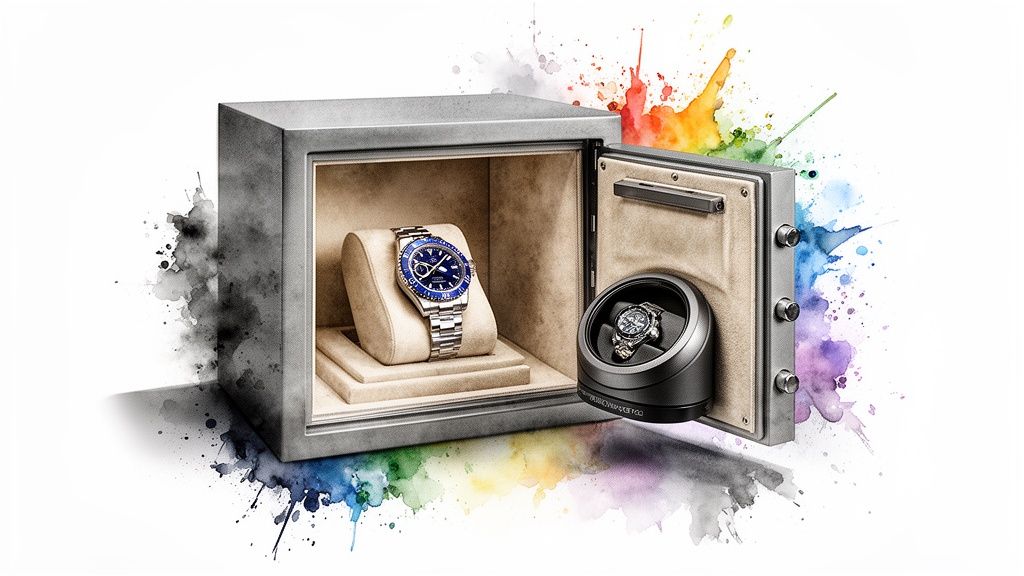 An open safe storing two luxury watches, a blue Rolex and another in a winder, with vibrant watercolor splashes.
This strategy isn't just for single, irreplaceable pieces, either. I know collectors who use private vaults to store watches that aren't in their current rotation, essentially creating their own Fort Knox for their horological assets.
Bank Safe Deposit Box vs. Private Vault
At first glance, a bank box and a private vault seem like the same thing. They're not. They cater to different needs and offer very different experiences, so it’s crucial to understand the distinction before deciding on the right Rolex watch storage solution.
A bank safe deposit box is the classic, old-school choice. You get the benefit of a bank's heavy-duty, time-tested security. The big downsides? Access is usually limited to banking hours (no grabbing a watch for a Saturday night event on a whim), and the environment isn't climate-controlled, which isn't ideal for the delicate mechanics of a luxury watch.
A private vault is a different beast entirely. These are purpose-built facilities for high-value assets. Many offer 24/7 access with biometrics, boast security that would make a spy movie jealous, and maintain strictly controlled climate conditions. It’s less like renting a box and more like having a personal, ultra-secure annex for your collection.
Here’s a quick breakdown of how they stack up:
| Feature | Bank Safe Deposit Box | Private Vault Facility |
|---|---|---|
| Accessibility | Limited to standard banking hours. | Often 24/7 with biometric access. |
| Security | High, but part of a general banking facility. | Specialized, often with multiple security layers. |
| Climate Control | Generally not offered. | Standard feature to protect sensitive assets. |
| Insurance | Not automatically insured by the FDIC or the bank. | Typically requires separate insurance; some offer it. |
| Privacy | High, but tied to a banking institution. | Often offers greater anonymity and discretion. |
Here’s the single most important thing to know about bank safe deposit boxes: Your property is not automatically insured by the bank or the FDIC. You absolutely must have your own valuable articles policy. Too many people learn this devastating lesson after it’s too late.
Critical Questions to Ask Your Vault Provider
Before you hand over your Rolex, you need to vet the facility. Don't be shy about it. You're not just renting a space; you're entrusting a significant asset to a third party. Treat this process with the same level of diligence you used when you first bought the watch.
A reputable company will expect and welcome tough questions. If they get defensive or vague, that’s a major red flag.
Walk in with a list. Here are the non-negotiables you need to ask:
- What are your exact access procedures and hours? Get specific. Can you get in on a Sunday? A bank holiday? What if you need access at 10 PM?
- Can you detail your security layers? Go beyond "we have cameras." Ask about on-site guards, third-party alarm monitoring, motion sensors, and biometric scanners.
- Is the facility climate-controlled? Ask for specifics on their humidity and temperature regulation. A stable environment is key to preserving gaskets, oils, and delicate parts.
- What is your insurance liability? You need to know precisely what their policy covers and, more importantly, what it doesn't. This will inform your own insurance needs.
- Who else has access to the vault area? Find out about their employee vetting process, background checks, and internal access protocols. You want to minimize any chance of an inside job.
Opting for off-site storage means trading a bit of convenience for an incredible amount of security. By asking the right questions and understanding what you’re paying for, you can build a true fortress for your collection and enjoy the hobby without the constant worry.
Protecting Your Rolex from Environmental Threats
When we think about Rolex security, our minds jump to heavy-duty safes and bank vaults. That's a great start, but it's only half the battle. The silent, creeping threats from the environment can be just as damaging over time. Your watch is an intricate machine, and it's surprisingly sensitive to heat, moisture, and even the box you keep it in.
Think of it this way: proper Rolex watch storage is about creating a stable micro-environment. Big temperature swings are a major problem. High heat can cause the specialized lubricants inside the movement to thin out or even evaporate, leading to accelerated wear on tiny, critical parts. On the flip side, extreme cold can thicken those same oils, throwing off the watch's accuracy.
Moisture is an even sneakier enemy. Sure, your Rolex Oyster case is built like a submarine, but its water resistance depends on a series of rubber gaskets. Over the years, high humidity or, conversely, overly dry air can make these seals brittle. They can lose their elasticity and compromise the case's integrity, and you'd never know until it's too late.
Finding the Ideal Storage Climate
Your goal here is to create a controlled space that's consistent—think museum-quality preservation, but without the high-tech lab. You just need to keep a few key numbers in mind to prevent the slow, cumulative damage that leads to very expensive service bills.
The sweet spot for long-term storage is all about stability.
- Ideal Humidity: Keep the relative humidity between 40% and 50%. This is dry enough to prevent any risk of moisture getting in but not so bone-dry that it dehydrates the gaskets.
- Stable Temperature: A consistent room temperature, ideally between 65-75°F (18-24°C), is perfect. This means avoiding attics, basements, or garages where temperatures can skyrocket or plummet with the seasons.
A simple digital hygrometer—you can grab one online for less than a cup of coffee—is a must-have tool. Just pop one inside your safe or storage box. It gives you an instant, accurate reading of the conditions and lets you know if you need to make any adjustments.
You wouldn't store a classic car in a damp barn or a blistering hot shed and expect it to start right up years later. Your Rolex deserves that same level of care. Its lubricants, seals, and metal components are just as sensitive to the elements.
The Hidden Danger of the Original Box
It feels natural to put your Rolex back in that beautiful green box it came in. For a few weeks or months, that's perfectly fine. But for long-term storage, it can be a surprisingly bad idea. The materials used in many watch boxes—certain glues, foams, and synthetic leathers—can actually break down over the years.
This process is called off-gassing, and it can release chemical vapors that tarnish or discolor your watch's case and bracelet. I've personally seen vintage pieces pulled from their original boxes after a decade with a weird film on the metal, all because the box interior was slowly deteriorating. A much better option is a high-quality watch case lined with a soft, inert material like Alcantara or microfiber.
Keeping the Movement Healthy in Storage
A watch in storage isn't just a static piece of metal; it's a dormant machine. To keep everything in prime condition, the internal parts need to move every now and then. Letting an automatic watch sit completely still for years can cause its lubricants to pool and settle, which is terrible for the long-term health of the movement.
A little proactive maintenance goes a long way here.
- Give It a Gentle Wind: Once a month or so, take the watch out. Unscrew the crown and give it a full manual wind—about 40 turns should do it.
- Cycle the Complications: Set the time and date, running the hands through a full 24-hour cycle to make sure the date wheel and other functions engage.
- Let It Run: Let the watch run for a few hours, or even a full day, before putting it back in storage.
This simple routine keeps the lubricants evenly distributed and ensures all the mechanical parts stay limber. It’s the best way to make sure that when you’re ready to wear your Rolex again, it performs as flawlessly as the day you put it away.
The Paper Trail That Protects Your Investment
Physical security is one thing, but what happens when a determined thief or a disaster like a fire bypasses your safe? That’s when your paper trail—the collection of receipts, photos, and warranty cards—becomes your single most important tool for recovery and insurance claims.
Without proper documentation, your stolen Rolex is just another watch to the police and your insurer. With it, you have a specific, identifiable asset with a unique serial number that can be flagged across the globe. Getting your paperwork in order is the foundation of any solid Rolex watch storage plan.
Documenting Your Rolex Like a Pro
Building a complete file on your watch doesn't have to be a chore, but it does demand a bit of precision. The idea is to create a complete dossier for each timepiece, leaving no doubt about its identity. This file will be your best friend when dealing with law enforcement and insurance adjusters.
First, take good, clear photos. And I don’t mean just a quick wrist shot. You need to capture every detail from multiple angles:
- The Dial: Get a crisp, straight-on shot in good lighting.
- The Case Back: Document any engravings or special markings.
- The Clasp: Make sure the Rolex coronet and any reference numbers are visible.
- The Serial Number: This is the big one. Use a macro lens or your phone’s best close-up setting to get a perfectly clear image of the serial number. On older models, it’s between the lugs; on newer ones, you'll find it on the inner rehaut (the ring between the dial and crystal).
- Unique Scratches or Marks: Every watch develops its own personality. That tiny nick on the bezel or a specific scuff on the bracelet is like a fingerprint. Document these "tells"—they can be the key to proving a recovered watch is actually yours.
Once you have the photos, pull everything together. Create a simple document listing the model number, serial number, purchase date, and what you paid. Scan the original sales receipt, warranty card, and any service records you have.
Think of your watch's paperwork like the title to your car. You wouldn't keep the title in the glove compartment, right? Apply the same logic here. Store the physical papers and box in a separate secure location, not right next to the watch. Keep encrypted digital copies in a cloud service for easy access.
Your Essential Rolex Documentation Checklist
Having a clear, organized record is your best defense. This checklist will help you build a comprehensive file for your timepiece, which is invaluable for insurance claims and recovery efforts.
| Document or Action | Purpose | Recommended Storage |
|---|---|---|
| High-Resolution Photos | Visual proof of ownership and condition. Captures unique identifying marks. | Encrypted cloud storage (e.g., Dropbox, Google Drive) and a physical hard drive. |
| Serial & Model Numbers | The single most important identifier for tracking and recovery. | Digital note-taking app, password manager, and physical document. |
| Original Sales Receipt | Proof of purchase, date, and original value. | Digital scan in the cloud; original in a fireproof document bag or safe. |
| Warranty Card/Papers | Confirms authenticity and links the serial number to the original sale. | Digital scan in the cloud; original in a fireproof document bag or safe. |
| Appraisal Certificate | Establishes current market value for insurance purposes (update every 2-3 years). | Digital scan in the cloud; original with your insurance agent and in a safe. |
| Service Records | Creates a history of maintenance and confirms authenticity over time. | Digital scans in the cloud; originals in a secure file. |
By methodically gathering and storing these items, you're not just organizing paperwork; you're building a powerful case to protect your asset long before anything goes wrong.
Getting the Right Insurance (Because Your Homeowner's Policy Isn't Enough)
Here’s a hard truth many owners learn too late: your standard homeowner's or renter's insurance is almost certainly not enough. Most of these policies have shockingly low limits for jewelry, often capping payouts at $1,500 to $2,500. For most Rolex owners, that wouldn't even cover the sales tax.
To properly protect your watch, you need a specialized valuable articles policy, sometimes called a "personal article floater" or a "rider." This is insurance designed from the ground up for high-value items like luxury watches.
Here are the non-negotiables to look for in a policy:
- Agreed Value Coverage: This is key. You and the insurer agree on the watch's value when the policy is written. If it’s stolen, that’s the amount you get—no arguments about depreciation.
- All-Risk Coverage: You want a policy that covers theft, damage, and even "mysterious disappearance" (i.e., you simply lose it).
- No Deductible: The best policies come with a $0 deductible. If you have to make a claim, you shouldn't have to pay anything out of pocket.
- Worldwide Coverage: If you travel with your watch, make sure it's protected wherever you go, not just when it's sitting at home.
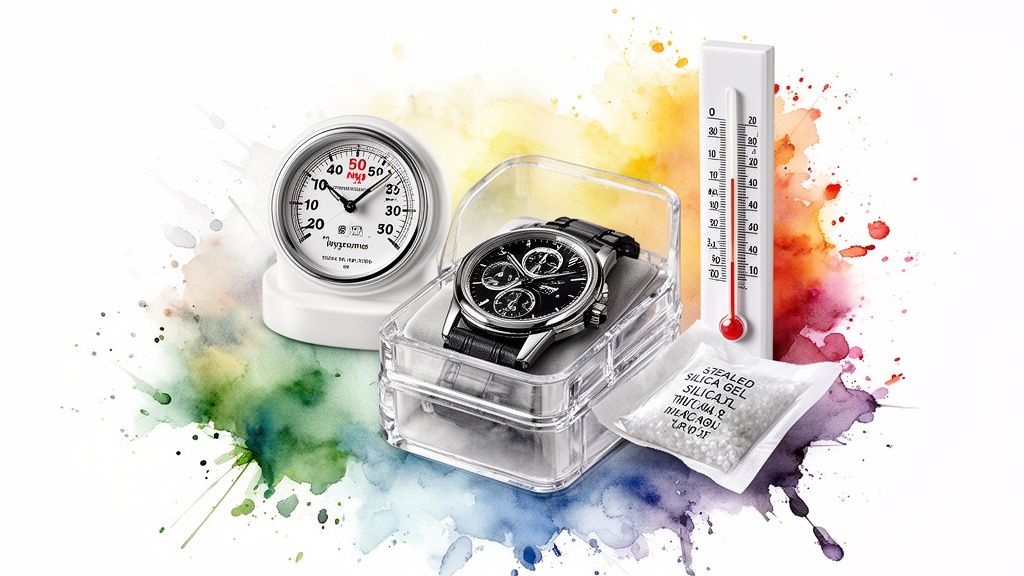 Chronograph watch in protective case, with hygrometer, thermometer, and silica gel for optimal storage.
Proactive Steps to Get Your Watch Back
Insurance is there to cover the financial loss, but what if you want your actual watch back? That's where you have to be proactive. Registering your watch's serial number on a global database like StolenWatch creates a digital tripwire.
If a thief ever tries to sell it to a reputable dealer, auction house, or even a pawn shop, a quick serial number search will instantly flag it as stolen. This not only makes it much harder for criminals to offload your property but also gives law enforcement a real chance at recovery.
The numbers don't lie. Thieves depend on poor record-keeping to get away with it. With an average of 21 high-end watches stolen daily in 2024—and Rolex making up almost half of them—the problem is real. In a city like London, a staggering one in 88 stolen luxury watches is ever recovered. They just keep circulating because their history isn't being checked.
By building that meticulous paper trail, getting the right insurance, and registering your watch, you're creating multiple layers of defense. You make your Rolex a much harder target and vastly improve your odds of a good outcome if the worst should happen. If you're looking into this, a detailed comparison of different stolen watch registries can help you decide which service is the best fit.
Common Questions on Storing Your Rolex
Once you've got the basics down—security, climate control, and documentation—the little details start to pop up. When it comes to something as valuable as a Rolex, it's natural to have questions about the finer points of storage. Let's tackle some of the most common ones I hear from fellow owners to help you store your timepiece with total peace of mind.
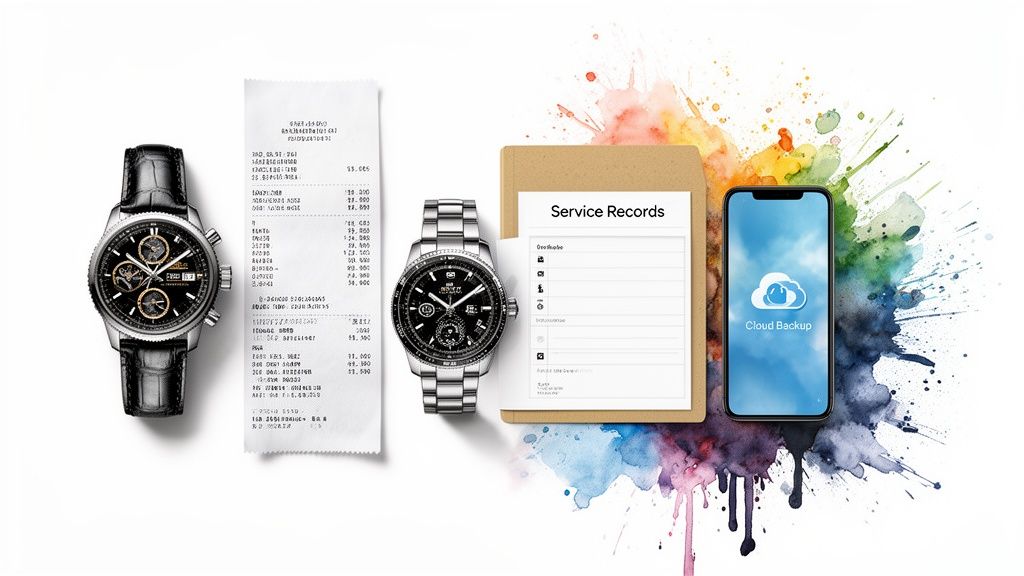 Two luxury watches, a receipt, service records, and a cloud backup phone against a colorful splash.
Is a Watch Winder Really Necessary for My Rolex?
This is probably the biggest debate in the watch community. The short answer? No, a winder isn't strictly necessary, but it's incredibly useful if you have an automatic watch that's part of a rotation.
A Rolex movement is a finely tuned machine that’s meant to be in motion. A winder keeps that mainspring perfectly wound and ensures the internal lubricants are spread evenly. This simple action prevents oils from pooling and thickening, which can throw off timekeeping and even cause premature wear and tear when you finally pick the watch up again.
If you wear the same watch every day, a winder is more of a convenience. But if you have a collection and some pieces might sit for weeks or months, a winder becomes an essential tool for maintaining the health of the movement. For most modern Rolexes, you'll want a winder with a bidirectional setting at around 650 Turns Per Day (TPD).
Should I Keep My Box and Papers with the Watch?
Absolutely not. Storing your Rolex inside its original box with all the papers is one of the most common and costly mistakes you can make. A thief who finds a "full kit" knows they have a much easier and more profitable item to sell on the black market.
It's like leaving the title to your car in the glove compartment—you're just making the thief's job easier.
The smart move is to store your watch in one secure spot (like your safe) and keep the box, warranty card, and receipts in a completely separate, equally secure location. This separation is a simple but powerful security layer, making it much harder for a burglar to walk away with an easy-to-flip package.
What Is the First Thing I Should Do If My Rolex Is Stolen?
In the awful event of a theft, every second counts. A quick, methodical response can dramatically increase your chances of getting your watch back and ensuring your insurance claim goes smoothly. The moment you realize your watch is gone, take these actions.
- File a Police Report: This is your first and most critical step. Give the police every detail you have, especially the serial number and high-quality photos. You absolutely need an official police report to file an insurance claim.
- Call Your Insurance Company: As soon as you have a police report number, open a claim with your insurer. Give them the same detailed documentation you provided to the police.
- Report It to a Global Database: Immediately register the watch as stolen on a service like StolenWatch. This creates an instant, international alert for dealers, pawn shops, and collectors. If anyone searches that serial number, it will be flagged as stolen property.
- Notify Local Dealers and Pawn Shops: It's not a foolproof step, but a quick call or visit to reputable local shops can sometimes intercept a thief trying to make a fast buck.
Can Humidity Really Damage My Watch Inside a Safe?
Yes, it's a bigger threat than most people realize. A safe is just an enclosed metal box. When the temperature outside it changes, condensation can form inside, creating a surprisingly humid microclimate. This is especially common for safes located in basements or garages.
This trapped moisture is a silent killer for watches. It can cause rubber gaskets to age and crack, compromising water resistance. Over time, it can even lead to microscopic spots of corrosion on the dial or hands, which will tank the watch's value.
The fix is simple and cheap: toss a rechargeable silica gel desiccant inside your safe. These little packs absorb excess moisture and keep the environment stable and dry, protecting your investment from this hidden danger. It's also worth looking into a detailed comparison of various watch registration services to see how an added layer of digital protection can fit into your security plan.
Ready to add a powerful layer of protection to your collection? At StolenWatch, we provide the essential tools for owners to report stolen timepieces and for buyers to perform crucial due diligence. Register your watch today to create a digital alert that protects your investment across the global market.
Related Articles
View all
Check Titan Watch Serial Number: Verify It's Original
Learn how to check a Titan watch serial number to confirm it's original and hasn't been reported stolen. Step-by-step guide with location and verification tips.

How to Obtain a Certificate of Authenticity for a Watch
Learn how to obtain a certificate of authenticity for a watch, what documents matter, and why a stolen-watch check should come before any certificate request.

How Can I Check My Rolex Serial Number A Definitive Guide
Wondering how can I check my Rolex serial number? This guide details how to locate and decode your number to verify age, authenticity, and ownership history.