What Is a Watch Reference Number?
Unlock the story of your timepiece. Our guide explains what a watch reference number is, where to find it, and why it's essential for value and authenticity.
StolenWatch Team
Watch Authentication Specialist at StolenWatch
Unlock the story of your timepiece. Our guide explains what a watch reference number is, where to find it, and why it's essential for value and authenticity.
A watch's reference number is essentially its "model number"—the specific code that tells you everything about its design, materials, and features for an entire production run. Think of it like a car model, say a "Honda Civic EX." Thousands are made, and they all share that same model name.
This is completely different from a serial number, which is unique to one single watch. Your Honda Civic EX has a unique Vehicle Identification Number (VIN) that belongs only to your car. In the watch world, the reference number is the model, and the serial number is the VIN. See our watch serial number lookup hub for how the two numbers work together.
Your Watch's Blueprint: The Reference Number
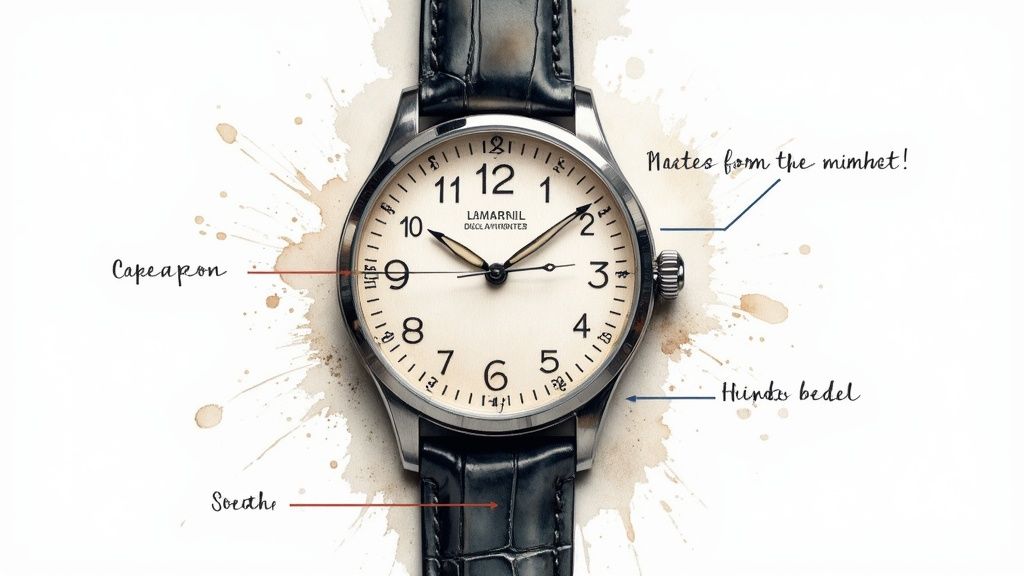 Elegant wristwatch with a cream dial and dark leather strap, set against a white background with brown splatters.
It's a common point of confusion for new watch owners, but the distinction is critical. The watch reference number is a universal code for a specific model family, while the serial number is a one-of-a-kind identifier for the physical watch you hold in your hand.
Reference Number vs. Serial Number At a Glance
To make this crystal clear, here’s a quick breakdown of what makes these two numbers fundamentally different.
| Identifier | Purpose | Uniqueness | Primary Use Case |
|---|---|---|---|
| Reference Number | Identifies the watch's model, materials, and features. | Shared by all watches of the same model. | Research, valuation, and buying or selling the correct model. |
| Serial Number | Identifies a single, unique physical watch. | Unique to one watch only. | Proving ownership, theft recovery, and tracking a specific piece. |
Simply put, the reference number tells you what the watch is, and the serial number tells you which one it is. Both are essential, but they answer very different questions.
The Foundation of Watch Identity
This reference number is your key to understanding what the manufacturer intended for your watch, right from the factory floor. It’s a standardized system that makes everything from valuation and authentication to sourcing the right parts for a service much, much easier.
This isn't a new concept. Iconic brands like Rolex started using reference numbers back in the early 20th century to keep their expanding catalogs organized. The very first Rolex Submariner, released in 1953, has the reference number 6204. Over time, these systems grew more complex, adding codes for bezel types, case materials, and movements, becoming the language of collectors and experts.
The reference number is the single most important identifier for understanding your watch. It is the language of collectors, insurers, and appraisers, providing the context needed to determine a timepiece's history, legitimacy, and market value.
Why This Number Matters To You
Knowing your watch's reference number is what elevates you from a casual owner to an informed enthusiast. It's the first and most important step toward protecting your investment and truly appreciating its heritage. Without it, a huge piece of your watch's story is missing.
Throughout this guide, we'll dig into the practical side of things, showing you:
- Where to locate your reference number on the watch case and its accompanying documents.
- How to decode the numbers from major brands like Rolex and Omega.
- The critical role it plays in insurance, theft recovery, and market valuation.
By the end, you'll see this isn't just a technical detail. It's the very foundation of your watch's identity.
How to Find Your Watch Reference Number
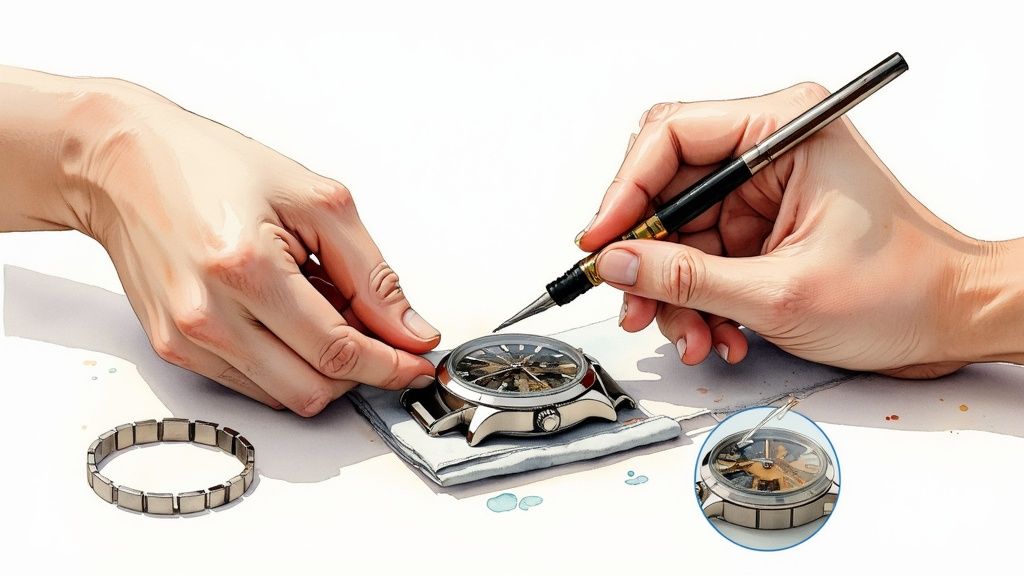 Close-up of hands using a precision tool to work on a mechanical watch.
Finding your watch’s reference number can feel like a bit of a treasure hunt, but this vital piece of information is usually hiding in one of a few predictable spots. Once you know where to look—and just as importantly, how to look—you can quickly uncover your timepiece's true identity.
The easiest place to start is with the original paperwork. Dig out the warranty card, sales receipt, or certificate of authenticity that came with your watch. The reference number should be clearly printed, making this your first and safest port of call before you even touch the watch itself.
On the Watch Case Itself
If you don't have the papers handy, your next stop is the watch case. Manufacturers almost always engrave the reference number directly onto the steel, but the exact location can differ quite a bit between brands and even models.
Here are the most common places to check:
- On the Caseback: This is a popular spot. Brands like Omega and TAG Heuer often engrave the reference number right on the back of the case. Just be careful not to confuse it with the serial number, which is often nearby.
- Between the Lugs: This is Rolex's signature placement. You'll need to carefully remove the bracelet to find it. The reference number is typically engraved at the 12 o'clock position, with the watch's unique serial number at the 6 o'clock side.
- Inside the Caseback: On some vintage pieces or more obscure models, the number is hidden on the interior of the caseback. Getting to it means opening the watch, which is a job best left for a professional watchmaker to avoid causing any damage.
Pro Tip: Those engravings can be incredibly small and often wear down over the years. A jeweler's loupe or even the zoom function on your smartphone camera is your best friend here. It makes reading those tiny digits a whole lot easier.
When You Can't Find It Physically
What happens if the number is worn down to nothing or the paperwork is long gone? Don't panic. You still have a few paths forward.
First, turn to the internet. Online watch databases and brand-specific forums are fantastic resources. You can often find your model by visually comparing it to pictures in an extensive catalog. Posting clear photos on an enthusiast forum can also yield quick results, as seasoned collectors can spot a model from a mile away.
When all else fails, your best bet is to visit a trusted watchmaker or an authorized dealer. Their trained eyes can identify most watches in an instant, picking up on subtle design cues the rest of us would miss. They can also safely open the case to check for internal markings, confirming the correct watch reference number and giving you the essential blueprint for your timepiece.
Cracking the Code: What Your Watch's Reference Number is Telling You
A watch reference number can look like a random jumble of letters and numbers, but for the big names like Rolex, Omega, and Patek Philippe, it’s a language. Each part of that code tells a story, revealing the watch's most essential traits. Once you learn to speak this language, that confusing string of characters becomes one of the most powerful tools at your disposal.
Think of it as a decoder ring for your timepiece. With a little knowledge, you can instantly tell a watch’s model family, the type of movement ticking inside, the case material, the style of the bezel, and sometimes even the exact color of the dial. Let's break down a few real-world examples to show you how it works.
Reading a Rolex Reference Number
Rolex is famous for its logical, structured reference numbers. They manage to pack an incredible amount of detail into a surprisingly short code. We'll use a modern classic to illustrate: the Rolex Submariner Date, reference 126610LN.
Here’s a quick breakdown of what that code means:
- 1266: The first four digits typically identify the model family (in this case, the Submariner) and point to the specific generation of its movement.
- 1: The next number tells you about the bezel. Here, '1' signifies a rotatable bezel, a hallmark of a dive watch.
- 0: This last digit reveals the case material. For Rolex, '0' means it’s made from their robust Oystersteel.
- LN: These letters at the end describe the bezel's color. "LN" is shorthand for Lunette Noir, which is just French for a black bezel.
This image shows you where to find the reference and serial numbers on a typical Rolex case, tucked away between the lugs.
Once you understand this system, you can see how a small change, like a green bezel instead of a black one, leads to a completely different reference number—and often, a completely different market value.
Unpacking an Omega Product Identification Code
Omega uses a slightly different system they call the Product Identification Code (PIC). It’s a longer, more detailed number, but it gives you an even more granular look at the watch's specifications. Every segment of the PIC corresponds to a specific feature.
For instance, a modern Omega Seamaster could have a reference like 210.30.42.20.01.001. This code tells you everything, from the watch collection and case material right down to the specific dial and bracelet combination. That level of precision is crucial when you're looking to buy a watch, order a specific part, or get it insured. The sheer amount of data packed into these codes is exactly why they're so vital for everything from basic authentication to in-depth certificate verification.
A watch reference number is the key to its identity. It’s the DNA that contains the manufacturer’s original blueprint, distinguishing a stainless-steel model from a gold one, or a blue dial from a black one, with just a few characters.
The impact these codes have on the market is massive. Reference numbers directly influence a watch's resale value, and you’ll find collectors hunting for very specific variations. In fact, data from one of the largest luxury marketplaces shows that for top-tier brands like Rolex, certain "hot" reference numbers can drive up to 37% of all collector demand. This desirability, of course, also makes those same models prime targets for sophisticated counterfeiters.
Why Your Watch's Reference Number Is So Important
https://www.youtube.com/embed/LO60gD_JEXU
Knowing where to find your watch's reference number is one thing. Understanding why it's so critical is another. This isn't just a string of technical characters; it's the key to your watch's identity, value, and security. Think of it as the blueprint for your timepiece.
For anyone buying, selling, or collecting, the reference number is the ultimate guide to market value. It’s what separates a standard stainless-steel model from a rare, limited-edition platinum version—a difference that can easily translate to tens of thousands of dollars. It's the very first thing any expert will look for.
The Key to Authenticity and Proper Service
A reference number that doesn't match the watch is an immediate red flag. It’s a tell-tale sign of a potential counterfeit or a "Frankenwatch"—a timepiece cobbled together from mismatched, non-original parts. True authenticity means every detail of the watch aligns perfectly with the story told by its reference number.
This code is also your watchmaker's best friend. When you take your watch in for service, they rely on the reference number to order the exact, factory-correct parts. Without it, finding the right crystal, crown, or movement component is pure guesswork that can seriously compromise your watch's performance and integrity.
A watch without a verifiable reference number is like a car without a VIN. You can't prove what it is, where it came from, or what it's truly worth, making it nearly impossible to sell, service, or insure with confidence.
The Foundation of Financial and Security Protection
Beyond the world of collectors, the reference number plays a huge role in protecting your investment. Insurance companies need this specific code to write an accurate policy. It gives them the precise model details required to assess its replacement value, making sure you're fully covered if it's ever lost, damaged, or stolen.
And if theft does occur, the reference number is invaluable. While the serial number identifies your unique watch, the reference number tells law enforcement and recovery services exactly what kind of watch they're looking for. You can see how this works in practice by running a quick search of the stolen watch database.
This isn't just a local issue. The reference number is a universal identifier used to track sales and trends across global markets. For instance, the Asia Pacific region currently dominates the luxury watch market, where timepieces with highly desirable reference numbers are treated as serious investments. Mordor Intelligence offers some great insights into how these trends shape the industry.
Let's break down a famous Rolex reference number, 126610LN, to see how the code relates to the watch itself.
 A completely black image, containing no visible content, patterns, or details.
As the breakdown shows, the model number (126610) and the bezel code (LN) combine to define one specific version of a Rolex Submariner. Every single character matters.
How Different People Use Reference Numbers
 Two men in suits stand on concrete podiums flanking a large golden watch with a brown strap.
A watch's reference number isn't just a string of technical jargon for enthusiasts to debate online. It's the universal language of the watch world, connecting everyone from a first-time buyer in a boutique to an investigator tracking a stolen piece.
Think of it as the watch's DNA profile. It’s the single piece of information that everyone—buyers, sellers, insurers, and police—relies on to understand exactly what they're dealing with. Let's break down who uses it and why it's so critical.
For Buyers and Collectors
If you're in the market for a pre-owned timepiece, the reference number is your best friend. It’s your primary tool for doing your homework before you ever spend a dime. With that number, you can instantly look up the watch's factory specs—the case metal, the dial color, the bezel type, everything—and make sure the watch in front of you matches.
A missing or altered reference number is a massive red flag. It could mean you're looking at a counterfeit or a "Frankenwatch," a timepiece cobbled together from mismatched parts. For serious collectors, that code is even more important; it helps them hunt down incredibly rare variations where one digit can be the difference between a common find and a grail piece worth a fortune.
For Sellers and Retailers
When you're selling a watch, trust is your most valuable asset. The watch reference number is the key to building that trust by creating a perfectly accurate listing. It allows you to research and set a fair market price based on what that specific model has recently sold for.
Retailers lean on it heavily for everything from managing inventory to ordering new stock and talking to the brands. It cuts through any confusion, ensuring the right watch is shipped and that service centers get the correct parts for repairs. A clear reference number gives buyers the confidence to pull the trigger.
A reference number acts as a universal translator. It allows a buyer in Tokyo, a seller in New York, and an insurer in London to all understand the exact identity and specifications of a single timepiece without ever seeing it in person.
For Insurers and Law Enforcement
For an insurance agent, the reference number is non-negotiable. You can't write a proper policy without it. That code tells the insurer everything they need to know—the materials, the movement, the model—to accurately assess its replacement value. This ensures the owner is fully covered if the watch is ever lost, damaged, or stolen.
When theft does happen, this number becomes a crucial piece of evidence for law enforcement. While the unique serial number identifies the exact stolen item, the reference number describes what that item is. It helps an officer immediately recognize the watch if it's pawned or listed for sale online. It’s also the key to logging the theft in global databases; you can see how this works in the recovery of stolen Rolex watches. That simple code turns a vague report into a precise, actionable lead, dramatically increasing the odds of getting it back.
The reference number isn't just a technical detail; it's a vital tool with specific, high-stakes applications for different people in the watch community. Each group relies on this code to bring clarity, security, and value to their work.
Reference Number Use Cases by Role
| Role | Primary Use | Key Benefit |
|---|---|---|
| Buyer/Collector | Verifying authenticity and specifications | Prevents buying fakes or "Frankenwatches" |
| Seller/Retailer | Creating accurate listings and managing inventory | Builds trust and ensures fair market pricing |
| Insurer | Determining accurate replacement value for a policy | Guarantees proper coverage for the owner |
| Law Enforcement | Identifying and recovering stolen property | Provides a precise description for investigations |
From making a smart purchase to solving a crime, the reference number is the common thread that provides an undeniable, verifiable identity for every luxury watch.
Your Questions Answered: A Watch Reference Number FAQ
Even with a solid grasp of the basics, a few specific questions always seem to surface when people start digging into reference numbers. It's completely normal. Let's tackle some of the most common ones that come up for both seasoned collectors and new owners.
Think of this as the practical part of the conversation, where we clear up those lingering doubts and "what if" scenarios.
Can Two Different Watches Have the Same Reference Number?
Yes, they absolutely can—and they should! A reference number isn't unique to a single watch; it's unique to a specific model.
A great analogy is the car industry. Think of a "Honda Civic LX." Honda makes thousands of them, and they all share that same model name. In the watch world, every Rolex Submariner Date with a black bezel and steel case made during a certain period has the reference number 126610LN. It’s the model identifier.
The serial number, on the other hand, is like a car’s VIN. It is exclusive to one specific watch. No two timepieces from the same brand should ever share a serial number.
The rule is simple: a shared reference number is normal; a shared serial number is impossible. This distinction is the bedrock of watch identification, crucial for everything from authentication to theft recovery.
Does the Reference Number Tell Me When My Watch Was Made?
Not directly, no. But it does give you some excellent clues. A reference number corresponds to a model's production run, which could last for several years or even a decade. For instance, a particular reference might have been manufactured from 2010 to 2018.
So, while the reference number places your watch within that eight-year window, it won’t give you the exact year of birth. To get that specific, you usually need to cross-reference the watch’s unique serial number with brand-specific production records or charts. That’s how you can really narrow it down.
What if I Can't Find a Reference Number on My Watch?
Don't panic if you can't spot a reference number on the case. This is especially common with vintage pieces where the engravings have worn down over decades of use, or on watches that have been polished a little too enthusiastically over the years.
Here’s what to do next:
- Look Inside: The number might be engraved on the inside of the caseback. This means the watch has to be opened, which is a job for a professional watchmaker. Trying it yourself risks damaging the movement or seals.
- Ask an Expert: A trusted watchmaker or an authorized dealer has a trained eye. They can often identify a watch just by looking at its unique features—the dial, the hands, the movement, and other design details. Their experience is priceless here.
- Tap into the Community: Online forums and brand-specific databases are fantastic resources. By posting clear, high-quality photos, you can often get an accurate identification from the global community of collectors and enthusiasts.
How Are Vintage and Modern Reference Numbers Different?
The systems have changed quite a bit over time. Vintage reference numbers, especially from the mid-20th century, were often much shorter and simpler—usually just four or five digits that gave you a basic idea of the model and material.
Modern reference numbers are a different story. They are much more complex and detailed. Brands now use longer alphanumeric codes to pack in a ton of information, specifying everything from the bezel type and dial color to the exact style of the bracelet. This shift really mirrors how much more diverse and detailed watch catalogs have become, meeting the demand from collectors who want to know every last detail about each model variation.
Brand-Specific Stolen Watch Checks
Combine your reference number with a serial check on the brand-specific database:
- Stolen Rolex database
- Stolen Patek Philippe database
- Stolen Cartier database
- Stolen Omega database
- Stolen Audemars Piguet database
Or run a free serial number check on any brand.
Protecting your timepiece starts with knowing its identity. Use the StolenWatch global database to register your collection or check a serial number before you buy, ensuring every transaction is secure and transparent. Visit StolenWatch to safeguard your watch today.
Related Articles
View all
A Guide to Winning at Antique Watch Auctions
Discover how to navigate antique watch auctions with confidence. Learn expert strategies for bidding, consigning, and verifying your next timepiece.

Check Titan Watch Serial Number: Verify It's Original
Learn how to check a Titan watch serial number to confirm it's original and hasn't been reported stolen. Step-by-step guide with location and verification tips.

How to Obtain a Certificate of Authenticity for a Watch
Learn how to obtain a certificate of authenticity for a watch, what documents matter, and why a stolen-watch check should come before any certificate request.