Serial Number on a Watch: Missing, Polished Off or Not Matching?
What to do when the serial number on a watch is missing, worn, polished off or different from the papers, and how to record a readable serial before theft.
StolenWatch Team
Watch Authentication Specialist at StolenWatch
What to do when the serial number on a watch is missing, worn, polished off or different from the papers, and how to record a readable serial before theft.
The serial number on a watch is the code that separates one example from every other watch of the same model. Most of the time it is easy to read. This guide covers the cases that are not: a serial that is missing, worn, polished off, partly legible or different from the warranty card, and what each situation can mean for a buyer or an owner.
Looking for where the number is engraved? Our guide to finding a watch serial number shows the location brand by brand. Already have a readable serial? Check it against stolen-watch records before you buy.
More Than Just a Number
Every single luxury watch is given a unique serial number, a code that sets it apart from all others ever made by that brand. It's not just some random production stamp; it's the very soul of the watch's identity. For anyone who owns, collects, or insures fine timepieces, this number is gold.
In the worst-case scenario of theft or loss, that serial number is your non-negotiable proof of ownership for police reports and insurance claims.
And if you're in the market for a pre-owned watch? The serial number is your first line of defense. It lets you dig into the watch's background, check its legitimacy, and run it against global stolen watch databases. A quick search can save you from accidentally buying a stolen piece and the headache that comes with it.
The Cornerstone of Provenance
You can think of the serial number as the first page of your watch’s biography. Watchmakers have been using these identifiers for a very long time to keep track of their creations.
Rolex, for example, offers a great look into this. Their system has evolved over a 98-year history, starting all the way back in 1926 with serial number 28000. For 61 years, from 1926 to 1987, they used a straightforward, sequential numeric system. This meticulous record-keeping made it possible for collectors and historians to trace nearly every watch from that era, making Rolex one of the most well-documented brands out there. You can dive deeper into the history of Rolex serial numbers on bernardwatch.com.
A watch without a clear, verifiable serial number is a watch without a history. It's an immediate red flag that questions both its authenticity and its legal ownership—a massive risk for any buyer.
Getting familiar with your watch's serial number is just part of being a responsible owner. It gives you the power to:
- Insure Your Asset: Your insurer needs this exact number to provide proper coverage.
- Verify Authenticity: You can cross-reference the number with brand records or an appraiser.
- Prevent Fraud: Always check databases like StolenWatch before buying pre-owned.
- Establish Provenance: Trace the production year and confirm its history is accurate.
This guide will show you exactly how to find, record, and use your watch's serial number. It's the key to protecting your investment and appreciating the unique story on your wrist.
A Quick Look at Common Serial Number Locations
Finding your watch's serial number can sometimes feel like a treasure hunt. Manufacturers have their own unique spots for this critical identifier, and the location often changes depending on the brand, model, and even the year it was made. It's rarely obvious—brands intentionally place these numbers in discreet areas to maintain the watch's clean aesthetic.
For many older or vintage timepieces, you might need to get your hands a little dirty. On a classic Rolex, for instance, the serial number is traditionally engraved between the lugs at the 6 o'clock position. You'll find the model number in the same spot, but at 12 o'clock. To see either, you have to carefully remove the bracelet, which usually requires a spring bar tool and a very steady hand to avoid scratching the case.
Thankfully, modern watches often make things a bit easier.
Common Hiding Spots for Key Brands
In recent years, many watchmakers have moved their serial number engravings to more user-friendly or secure locations. Rolex, for example, started adding the serial number to the inner bezel ring (the rehaut) around 2005. You can now spot it just by looking through the crystal at the 6 o'clock position, no tools required. This was a game-changer.
Other major brands have their own distinct habits:
- Omega: Check the exterior of the case back or one of the lugs first. On many vintage Omegas, however, the number is engraved directly on the movement, which means a watchmaker has to open the case to see it.
- TAG Heuer: This is usually straightforward. You’ll almost always find both the serial and model numbers clearly engraved on the case back.
- Seiko: The case back is your best bet here, too. Seiko typically engraves a six or seven-digit serial number that not only identifies the watch but can also tell you its production month and year.
The placement of a watch's serial number is a deliberate choice by the manufacturer, balancing security, aesthetics, and ease of access for servicing. Knowing where to look is the first step in properly documenting and protecting your investment.
Special Cases and Handy Tools
For certain high-end or historically significant watches, the search can get a bit more involved. With a Patek Philippe, you're looking for two separate numbers: a movement number and a case number. Both are crucial for authentication. The movement number is, unsurprisingly, on the movement, while the case number is usually tucked away on the inside of the case back.
The infographic below shows just how much information is tied to that single string of digits.
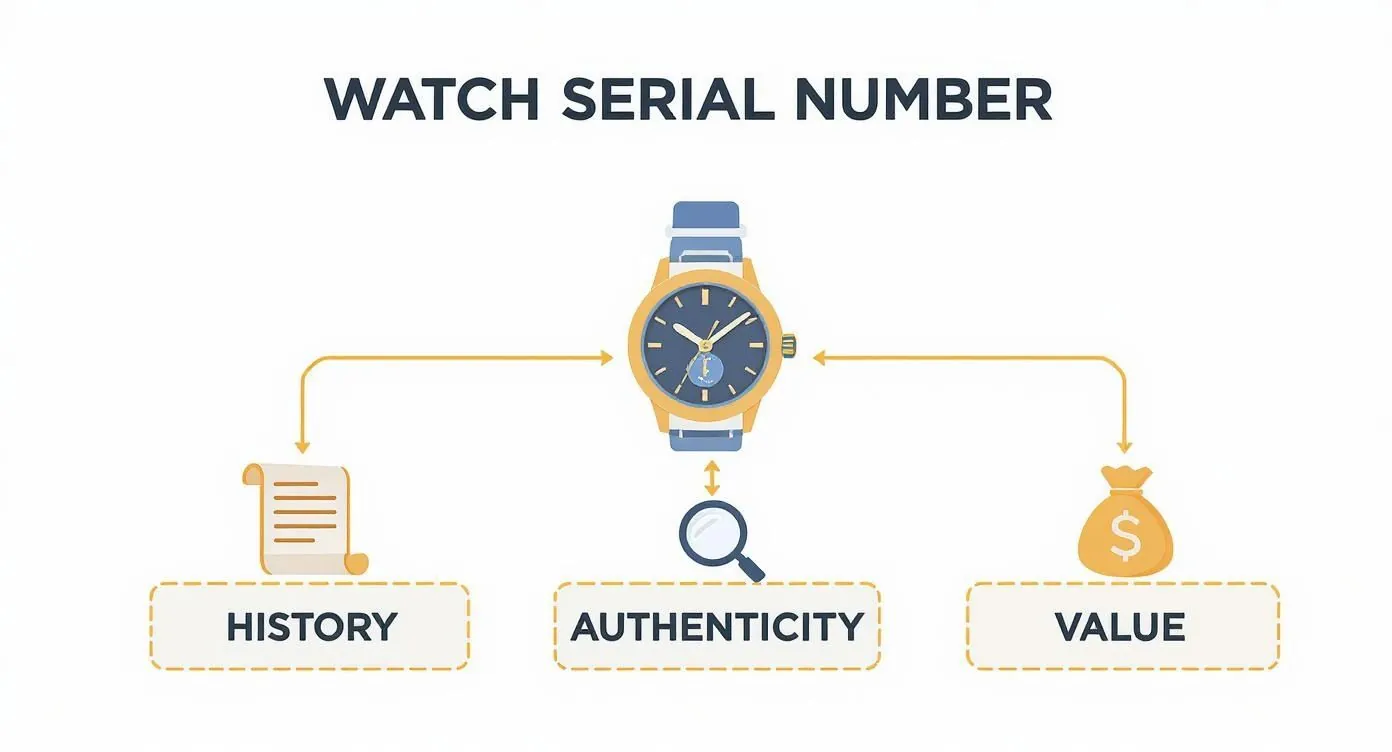 Infographic showing a watch serial number provides insights into its history, authenticity, and value.
As you can see, that one number is the key to unlocking a watch's history, confirming its authenticity, and supporting its value.
To make your search easier, here’s a quick-reference table for some of the most popular brands.
Common Serial Number Locations by Watch Brand
| Brand | Primary Location | Secondary Location(s) | Notes / Tools Needed |
|---|---|---|---|
| Rolex | Inner bezel (rehaut) at 6 o'clock (modern) | Between the lugs at 6 o'clock (vintage) | Spring bar tool for vintage models |
| Omega | Case back exterior or lugs | On the movement (vintage) | Watchmaker needed for movement check |
| TAG Heuer | Case back exterior | N/A | Usually easily visible |
| Patek Philippe | Inside of the case back (case number) | On the movement (movement number) | Watchmaker needed to open the case |
| Breitling | Case back exterior | Between the lugs (some models) | Spring bar tool may be needed |
| Audemars Piguet | Case back exterior | N/A | Typically engraved prominently |
| Seiko | Case back exterior | N/A | Serial number can also date the watch |
This table should give you a solid starting point, but remember that exceptions always exist, especially with older or limited-edition models.
And if you're ever performing due diligence on a pre-owned piece, checking that number against a reliable database is a non-negotiable step. Our detailed registry of stolen Rolex watches is an essential resource for protecting yourself.
Photographing Your Watch Serial Number
Once you’ve found the serial number, the next move is to get a sharp, clear photograph of it. This isn't just a happy snap for your camera roll; this picture is your proof. It's what you'll send to the insurance company, show a potential buyer, or keep in your personal files as a permanent record.
The problem is, these engravings are often incredibly small and shallow, and they're usually on highly reflective surfaces like polished steel or gold. Trying to get a good picture can be frustrating.
 A person holds a white smartphone with a woman's portrait and a serial number on its back.
But don't worry, you don't need a professional camera setup. Your smartphone is more than capable of nailing this shot if you know a few tricks. Most modern phones have a dedicated macro mode for extreme close-ups—this is exactly what you need. If your phone doesn't have one, you can buy a cheap clip-on macro lens online that will work just as well.
Mastering Light and Angles
Glare is your number one enemy here. The built-in flash on your phone is a guaranteed way to blast the engraving with light, making it completely unreadable. The trick is to use soft, indirect light instead.
Here are a few ways I get the shot without the glare:
- Go for natural light. Find a spot near a window on an overcast day. Bright, indirect sunlight is perfect.
- Use what you have. A simple desk lamp is great, but don't point it directly at the watch. Instead, bounce the light off a white wall or the ceiling to create a soft, even glow that kills the harsh reflections.
- Play with the angles. Don't just shoot head-on. Tilt the watch and your phone slightly, taking pictures from different perspectives. You'll often find that a slight angle is what makes the numbers suddenly pop.
Here's a little trick I've used for years: grab a plain white piece of paper and hold it between your light source and the watch. It acts as a diffuser, softening the light and cutting down glare dramatically. It can be the difference between a blurry mess and a crystal-clear image.
Build Your Digital Dossier
Your goal is more than just taking one picture. You're creating a complete digital file for your watch. Think of it as a bulletproof record of ownership that you can easily share with anyone who needs it, from your insurer to a future buyer.
For each watch, create a dedicated folder and make sure it includes:
- Plenty of photos: Get high-resolution shots of the serial number from a few different angles. While you're at it, take pictures of the dial, case back, bracelet, and any unique dings or scratches.
- A simple text file: Open up a doc and type out the brand, model number, and the full serial number. This gives you a searchable version you can easily copy and paste when needed.
- All the paperwork: Scan or take clear photos of the original receipt, warranty card, and any service records you have. These documents are vital for proving the watch's history and your ownership.
Save this entire folder somewhere safe and accessible, like a cloud service (Google Drive, Dropbox, etc.). That way, your records are protected if your computer dies and you can get to them from anywhere. Taking an hour to do this now will save you a massive headache later on.
How to Verify Your Watch's Authenticity
<iframe width="100%" style="aspect-ratio: 16 / 9;" src="https://www.youtube.com/embed/mh8HhhGbAN4" frameborder="0" allow="autoplay; encrypted-media" allowfullscreen></iframe>Now that you have the serial number, the real detective work begins. This number is more than just a random string of digits; it’s the key to unlocking your watch’s history and proving it's the genuine article. It’s not just about spotting a fake—it’s about making sure the timepiece has a clean past and isn't tangled up in a theft.
The most direct route for verification is often going straight to the source: the brand itself.
Many of the great watchmaking houses, like Omega or Patek Philippe, keep meticulous records. If you provide them with the serial and model numbers, they can sometimes issue an "Extract from the Archives." This document confirms the watch's original production details, and while there's usually a fee and a bit of a wait, it's about as definitive as it gets, especially for a vintage piece.
For a quicker check, a trusted authorized dealer or a seasoned watchmaker can be your best friend. They see these watches day in and day out and often have the brand connections to cross-reference a serial number for you.
Checking Against Stolen Watch Databases
This is the one step you absolutely cannot skip, especially in a private sale. Before any money changes hands, running the serial number through a stolen watch database is non-negotiable.
Think of it as the most critical piece of due diligence you can perform. A quick search on a platform like StolenWatch can save you from accidentally buying stolen property, which is a one-way ticket to legal headaches and losing your entire investment. Running the serial number on a watch through a global registry like this is the modern-day background check for your timepiece.
Identifying Common Red Flags
Beyond the official channels, you need to trust your own eyes. Counterfeiters are getting scarily good, but they almost always slip up on the tiny details, especially the engravings.
Keep an eye out for these tell-tale signs:
- Poor Engraving Quality: A genuine serial number is usually sharp, clean, and deeply cut with a diamond-tipped tool, giving it a distinct sparkle when it catches the light. Fakes often feature shallow, laser-etched numbers that look dull or have fuzzy, imprecise edges.
- Incorrect Font or Spacing: Brands are incredibly consistent with their fonts. Pull up high-resolution photos of confirmed authentic models online and compare them side-by-side with the watch in your hand. Any discrepancy in the typeface, size, or spacing between characters is a massive red flag.
- Mismatched Production Dates: For many vintage watches, the serial number can be traced to a specific production year. If you're looking at a Rolex with a serial number from the 1970s but it has design features that weren't introduced until the 1990s, you know something is very wrong.
The consistency between a watch's serial number, its physical features, and its documented history is the bedrock of authentication. If any one of these elements is out of sync, it undermines the entire story of the watch.
The Challenge of Modern Serial Numbers
Things get a bit trickier with modern watches. Back in 2010, Rolex threw a curveball by switching to a random eight-character alphanumeric system. This completely eliminated the ability for the public to date a watch by its serial number alone.
The older letter-prefix system, used from around 1987 to 2010, was predictable. Collectors had charts and could easily pinpoint a production year, which you can learn more about in this guide to Rolex serial number systems on wristicons.com. Unfortunately, counterfeiters exploited that predictability, which is exactly why the change was made.
For newer models, the serial number has become less of a historical clue and more of a pure, unique identifier for official verification. This is where a formal certificate verification process becomes invaluable, giving you a concrete way to validate a watch's authenticity and ownership in the current market.
Practical Steps for Owners and Buyers
 Top-down view of hands holding a smartphone displaying a watch, with a laptop and work items.
Knowing the serial number on a watch is one thing, but actually using that information is what protects your investment. Whether you've owned a timepiece for years or you're about to buy your first pre-owned classic, a few key actions can shield you from the headaches of theft, fraud, and loss. What you do now really can make all the difference later.
For anyone who currently owns a fine watch, your immediate job is documentation. This isn’t just paperwork; it’s about turning a beautiful object into a registered, protected asset. You're creating an undeniable link between you and that specific timepiece—a link that’s priceless if you ever need to file an insurance claim or report it stolen.
A great starting point is registering the watch directly with the manufacturer if they have a program for it. Many luxury brands keep a detailed database of owners, which helps with everything from service history to proving ownership. But the most critical call you'll make is to your insurance provider.
For Watch Owners Protecting Their Assets
When you talk to your insurer, that serial number is the single most important piece of information you can give them. It’s what allows them to list the watch as a "scheduled item" on your policy. Without it, you might only be covered for a generic, depressingly low amount if something happens. Trust me, it's a common and costly mistake that can leave you out thousands of dollars.
Here’s a quick checklist to make sure you're properly covered:
- Provide Serial and Model Numbers: Don't just tell them the numbers. Send clear photos of the engravings on the watch itself, along with the model number.
- Include the Appraisal: To insure the watch for its actual market value, you'll need to provide a recent, professional appraisal.
- Update Your Policy: Get written confirmation that your watch has been specifically added as a scheduled item to your homeowner's or renter's policy.
Failing to properly document and insure your watch with its serial number is like owning a car without a title. To an insurer or law enforcement, your claim to that specific item becomes incredibly difficult to prove.
For Buyers Navigating the Pre-Owned Market
If you're in the market for a pre-owned watch, your mindset needs to shift to one of cautious verification. That serial number is your best tool for due diligence. Any legitimate seller should be happy to provide clear, high-resolution photos of the engravings. If they get defensive, make excuses, or send you blurry pictures, that's your sign to walk away. No exceptions.
Before a single dollar is exchanged, you need to see that serial number and immediately put it to work. The most important step you can take is to check it against global databases of missing timepieces. It's incredibly easy to search a stolen watch database and see if the watch you're considering has been reported lost or stolen anywhere in the world.
This one search is your strongest defense against accidentally buying stolen property. Beyond that, ask the seller direct questions about the watch's story. Request the original papers, warranty card, and any service records. The serial number on that warranty card had better match the one on the watch perfectly. Any mismatch isn't just a red flag—it's a deal-breaker. A little diligence on your part protects you and helps keep the entire watch community honest.
When the Serial Number Is Missing, Worn or Doesn't Match
A serial number that cannot be read or does not agree with the paperwork is not proof that a watch is stolen or fake. It is a reason to slow down and get answers before money changes hands. Use this table to decide on the next step.
| What you see | What it can mean | What to do next |
|---|---|---|
| No serial where the brand normally puts one | The case may be replaced, refinished or not original. It can also be a counterfeit. Some inexpensive or fashion watches have no individual serial. | Confirm where the brand engraves the serial in our location guide. If it should be there and is not, ask the seller for the original papers or a service invoice that records it. |
| Engraving worn or faint from years of wear | Common on older watches worn daily. | Photograph it under angled light, then ask a watchmaker to read it with magnification. Do not guess the missing characters. |
| Serial polished off or deliberately scratched | Heavy polishing can soften engraving, but a cleanly removed serial on an otherwise sharp case is a serious warning sign. | Do not buy until the seller can explain it and show documents. An authorized service centre can often identify the watch from other markings. |
| Serial on the watch differs from the warranty card | The papers may belong to another watch, the case may have been replaced, or the papers may be forged. | Treat the papers as unverified. Ask for service records that show the serial on the watch itself, and check that serial, not the one on the card. |
| Only part of the serial is readable | Wear, an obstructed bracelet end, or a partly removed engraving. | Record the readable characters exactly and mark the unknown positions. A partial serial is useful to a watchmaker but should not be searched as if it were complete. |
Record your own serial before anything happens
The best time to read your serial is while the watch is in your hands and undamaged. Photograph it clearly, copy it exactly (including letters and leading zeros), and keep it with your purchase invoice and service records. If the watch is ever lost or stolen, that record is what lets a dealer or police officer match it to you. If it has already gone missing, you can report the stolen watch free and add the serial later if you find it on your paperwork.
Your Top Questions About Watch Serial Numbers
When you're dealing with watches, especially vintage or pre-owned pieces, serial numbers can feel a bit mysterious. It's natural to have questions, and getting them answered is the best way to protect your investment and make smart decisions. Let’s tackle some of the most common ones I hear from collectors and first-time buyers alike.
The more you know about these unique identifiers, the more confident you'll be, whether you're buying, selling, or just documenting your collection.
Can Two Watches Have the Same Serial Number?
For a genuine luxury watch, the answer is an emphatic no. Think of a watch's serial number like a car's VIN—it's a one-of-a-kind identifier assigned at the factory. If you ever find two watches from the same brand with the exact same serial number, you've stumbled upon a huge red flag.
This almost always points to counterfeiting. It means one, or more likely both, of the watches are fakes. Legitimate watchmakers keep incredibly detailed records specifically to prevent this from ever happening.
Does the Serial Number Tell Me How Much My Watch Is Worth?
Not directly, but it’s a critical piece of the puzzle. The serial number helps you pin down the watch's production date and confirm its model, both of which are absolutely part of its valuation. But the number itself isn't what drives the price.
A watch's real market value comes down to a combination of other things:
- Condition: This is huge. The state of the case, crystal, and movement is paramount.
- Rarity: Is it a limited run or a model that was only made for a short time?
- Provenance: Is there a fascinating ownership history? A famous past owner can send the value soaring.
- Completeness: Having the original box and papers—what we call a "full set"—makes a big difference.
The serial number is the watch's birth certificate, but its life story and current health are what truly determine its value.
What if the Serial Number Is Worn Off or I Can't Read It?
This happens all the time, especially with older watches that have seen a lot of wrist time. Decades of wear, or even a few too many aggressive polishing jobs during servicing, can make the engraving incredibly faint.
If you can't make out the number, don't guess. Your best move is to take it to a certified watchmaker or an authorized dealer for the brand. They have the right tools—like high-powered loupes and digital microscopes—and the trained eye to decipher markings that might look like a blur to the rest of us. Sometimes, even if the case number is gone, they can identify the watch using markings on the movement inside.
Brand-Specific Stolen Watch Checks
Once you have a serial number, run a brand-targeted check:
- Stolen Rolex database — Submariner, Daytona, GMT-Master, Datejust
- Stolen Patek Philippe database — Nautilus, Aquanaut, Calatrava
- Stolen Cartier database — Santos, Tank, Ballon Bleu, Panthere
- Stolen Omega database — Speedmaster, Seamaster, Constellation
- Stolen Audemars Piguet database — Royal Oak, Royal Oak Offshore
Or run a free serial number check across the full database.
Related Articles
View all
How to Tell If a Watch Is Fake A Complete Guide
Learn how to tell if a watch is fake with our expert guide. We cover weight, serial numbers, movement, and dial details to help you spot counterfeits.
How to Obtain a Certificate of Authenticity for a Watch
Learn how to obtain a certificate of authenticity for a watch, what documents matter, and why a stolen-watch check should come before any certificate request.
Citizen Serial Number Lookup: Eco-Drive & Vintage Guide
Find your Citizen serial number, identify Eco-Drive models and calibers, research vintage watches, and check for matching stolen-watch records.