How to Tell If a Watch Is Fake A Complete Guide
Learn how to tell if a watch is fake with our expert guide. We cover weight, serial numbers, movement, and dial details to help you spot counterfeits.
StolenWatch Team
Watch Authentication Specialist at StolenWatch
Learn how to tell if a watch is fake with our expert guide. We cover weight, serial numbers, movement, and dial details to help you spot counterfeits.
Spotting a fake watch isn't about finding a single "gotcha" flaw. It's about recognizing a pattern of imperfections. Think of it this way: you're building a case, and each small mistake is another piece of evidence. Your first line of defense is simply how the watch feels in your hand and the immediate impression it makes.
A genuine luxury watch feels solid, substantial, and immaculately finished. Fakes, on the other hand, often feel flimsy, light, and have rough, sharp edges. Before you even think about serial numbers or movements, start with this fundamental gut check.
Your First-Look Counterfeit Checklist
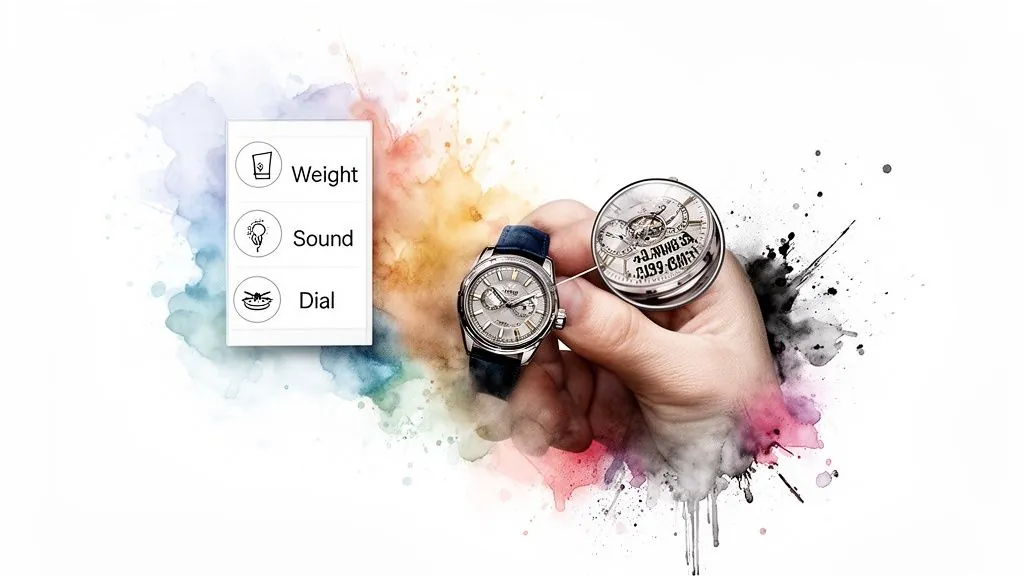 A hand inspects a wristwatch with a magnified view of its intricate mechanism, highlighting watch quality features.
Before you break out a loupe or get technical, your senses can tell you a lot. An experienced collector develops a feel for what’s real, and it starts with a simple principle: a genuine luxury timepiece is a precision instrument, while a fake is just a costume piece. The difference isn't just visual; it's tactile.
Authentication is rarely about finding one glaring mistake. Instead, it’s about piecing together the small slip-ups that reveal a counterfeit. Even the best "superfakes" almost always cut corners on the tiny details that define true watchmaking craftsmanship. This initial checklist helps you zero in on those crucial first clues.
The counterfeit industry is a staggering global problem. A stunning 40 million fake watches flood the market every year—that's roughly 25% more than the entire annual output of the Swiss watch industry. This figure alone shows why learning to spot a fake is so critical. You can find more in-depth reporting on the luxury watch market from sources like Persistencemarketresearch.com.
What to Feel and Hear
Counterfeiters are obsessed with appearance, but they often forget about the physical and auditory experience. Use this to your advantage.
- Weight and Balance: Pick it up. A real watch made from solid stainless steel, titanium, or precious metal has a satisfying density and feels balanced on the wrist. A fake made from cheaper plated alloys will feel noticeably light or hollow.
- Tactile Finishing: Gently run your fingers along the bracelet and the edges of the case. Authentic watches have perfectly smooth, polished, or brushed surfaces with no sharp points. Fakes often have rough, unfinished edges that can even snag on a shirt cuff.
- The Sound of the Movement: This is a classic test. Put the watch to your ear. Many fakes use a cheap quartz movement that produces a loud, distinct tick-tock once per second. A quality mechanical movement, in contrast, will have a much quieter, faster, and smoother sweeping sound—more of a rapid whirring.
What to See at a Glance
A quick visual scan can often expose the most common counterfeiting shortcuts. Look for anything that screams "lack of quality control."
The single biggest giveaway for a fake watch is a sloppy dial. Luxury brands invest millions in achieving perfection, so any misplaced text, smudged paint, or uneven font is a dead giveaway.
To make this even easier, I've put together a quick reference table. It breaks down the key differences you should look for right away, comparing the hallmarks of a genuine watch with the common red flags of a counterfeit.
Authentic vs Counterfeit Watch At-a-Glance
This table is your at-a-glance guide for that initial inspection. Use it to quickly compare what you're seeing and feeling against the known characteristics of genuine and fake timepieces.
| Characteristic | Authentic Watch Signs | Counterfeit Watch Red Flags |
|---|---|---|
| Weight | Substantial, dense feel from high-quality metals. | Surprisingly light or poorly balanced. |
| Dial Text | Crisp, perfectly aligned, and evenly spaced text. | Blurry, smudged, or misaligned lettering. |
| Second Hand | Smooth, sweeping motion (mechanical). | Jerky, ticking motion (cheap quartz). |
| Materials | Solid, finely brushed or polished metals. | Plated alloys, sharp edges, flimsy feel. |
Think of this table as your pocket expert. When you're assessing a watch, just run down the list. If you start seeing more red flags than authentic signs, it’s time to be very suspicious.
Time for a Hands-On Inspection
Alright, you've given the watch a quick once-over. Now it’s time to get serious and really put it under the microscope. This is where you graduate from a gut feeling to hard evidence, because the tiny details are exactly where counterfeiters slip up. Perfecting those details is expensive, and most fakes just don't go that extra mile.
Think of yourself as a detective picking up a clue-filled object. Every single component—from the dial and caseback to the crystal and clasp—is telling you a story. A genuine luxury watch is a masterpiece of precision engineering; any flaw, no matter how small, is a massive red flag.
Get Up Close with the Dial
The dial is the face of the watch, the first thing everyone sees, and it's often the first place a fake gives itself away. The big-name brands have an almost obsessive level of quality control here, so even the slightest mistake is a dead giveaway.
Grab a jeweler's loupe or just use your phone's camera zoom to get a good, close look at the text and logos. On a real watch, every single letter and number will be perfectly crisp with sharp, clean edges.
- Fonts and Spacing: Are the fonts fuzzy or blurry? Is the spacing between letters all over the place? Counterfeit printing techniques are no match for the high-resolution methods used by top-tier manufacturers.
- Lume Application: Check out the luminescent paint (the "lume") on the hands and hour markers. On a genuine timepiece, it's applied perfectly within its borders—no mess, no fuss. Fakes often have sloppy, blotchy lume that looks like it was painted on by a shaky hand, sometimes spilling over the edges.
- Date Window: If there's a date function, pay close attention to the cyclops lens that magnifies it. A real Rolex magnification, for example, is a very specific 2.5x, which is surprisingly difficult to replicate. Fakes usually have weak magnification, and the date wheel itself might be misaligned or use the wrong font.
A genuine watch dial is practically a work of art. Any smudges, specks of dust under the crystal, or misaligned markers are immediate signs that you're not looking at the real deal.
Flip It Over: The Caseback and Engravings
Now, turn the watch over and give the caseback a thorough inspection. This is another spot where fakers love to cut corners to save money. The engravings on an authentic watch are deep, precise, and clean, cut with high-end machinery.
Fakes, on the other hand, often have shallow, almost "sandy" looking engravings made from cheap acid-etching. Run your finger over the text and logos. You should feel distinct, sharp edges. If it feels smooth or has a gritty texture, be suspicious.
And if it's a display caseback where you can see the movement? Fakes will often have crudely decorated or totally unfinished parts. An authentic movement is a thing of beauty, with intricate finishing like Côtes de Genève (Geneva stripes) or perlage, even on components you can't easily see.
Feel the Difference: Bracelet and Clasp
A watch bracelet isn't just a strap; it's a crucial piece of engineering that contributes to the overall feel. Authentic bracelets use solid links, fit together with incredible precision, and feel smooth and comfortable on the wrist.
Take the bracelet in your hand. It should feel substantial and secure, with almost no rattling or play between the links. Fakes often use hollow links or poorly fitted solid ones that feel light, flimsy, and jangly. The screws holding the links should also be pristine, not stripped or poorly set.
Next, open and close the clasp a few times.
- It should click shut with a satisfying, secure sound.
- Any safety latch should engage firmly and smoothly.
- Engravings here should be just as deep and sharp as those on the caseback.
A clasp that feels gritty, loose, or is a pain to operate is a tell-tale sign of cheap manufacturing.
The Crown and Crystal Check
The crown—that little knob for winding and setting the watch—is a small detail that tells a big story. Winding a genuine mechanical watch should feel incredibly smooth, like turning a key in a well-oiled lock. A fake often feels gritty or rough, a sure sign of a low-grade movement inside. If it has a screw-down crown, the threads should engage cleanly without any grinding.
As for the crystal, most high-end watches use synthetic sapphire, which is exceptionally scratch-resistant. Here's a neat little trick: the water drop test. Place a single drop of water on the crystal. On real sapphire, the water's surface tension will make it bead up into a tight little dome. On cheaper mineral glass, it'll spread out and smear.
Finally, just feel the thing. The overall weight and materials are a huge tell. One of the best ways to spot a fake is simply by its weight—or lack thereof. A real Rolex Submariner, made from high-grade steel, has a satisfying heft to it, weighing around 150-200 grams. Fakes often feel suspiciously light because they're made from cheap alloys and even plastic parts. This quality gap exists because counterfeiting costs Swiss watch brands billions in lost sales, a massive economic incentive for them to invest in quality. You can dive into the full research about the luxury watch market to see just how big this problem is.
Listening to the Heartbeat of the Watch
Forget the dial and case for a moment. The real soul of a fine timepiece is its movement—that tiny, intricate engine that separates a genuine instrument from a convincing-looking accessory. Once you learn how to listen to and observe this "heartbeat," you'll be able to spot fakes that others miss, because counterfeiters almost never get the engineering right.
The first and most obvious clue is how the second hand moves. A quality automatic or mechanical watch doesn't just tick once per second. Its second hand glides in a smooth, continuous sweep, a motion created by the balance wheel oscillating between six to eight times every second.
Now, compare that to a typical counterfeit. Most fakes use a cheap, battery-powered quartz movement. This gives you that classic, jerky tick…tick…tick as the second hand stutters from one marker to the next. If you see this on a watch that's supposed to be a mechanical Rolex, Omega, or Patek Philippe, it’s a dead giveaway.
The Sound of Quality
Your ears are just as important as your eyes here. A genuine luxury movement is a symphony of quiet, controlled precision. Hold a real automatic watch close to your ear, and you might hear a faint, high-frequency whirring—the sound of hundreds of perfectly oiled parts working in harmony.
A counterfeit, on the other hand, is usually noisy. Listen for these red flags:
- A Gritty Rotor: Give the watch a gentle swirl. The rotor in a fake automatic often sounds loud and gritty, almost like there’s sand in the works. A genuine one should feel buttery smooth and be nearly silent.
- A Loud Tick: As mentioned, that slow, loud ticking sound is the signature of a cheap quartz movement trying to pass itself off as something it's not.
- Rattling Parts: Give the watch a gentle shake. A well-built movement is securely housed inside the case. If you hear anything rattling around, it's a bad sign.
This quick diagram shows the key physical checks you should be making, starting with the dial and working your way through the case and bracelet. It’s a systematic process, not just a single glance.
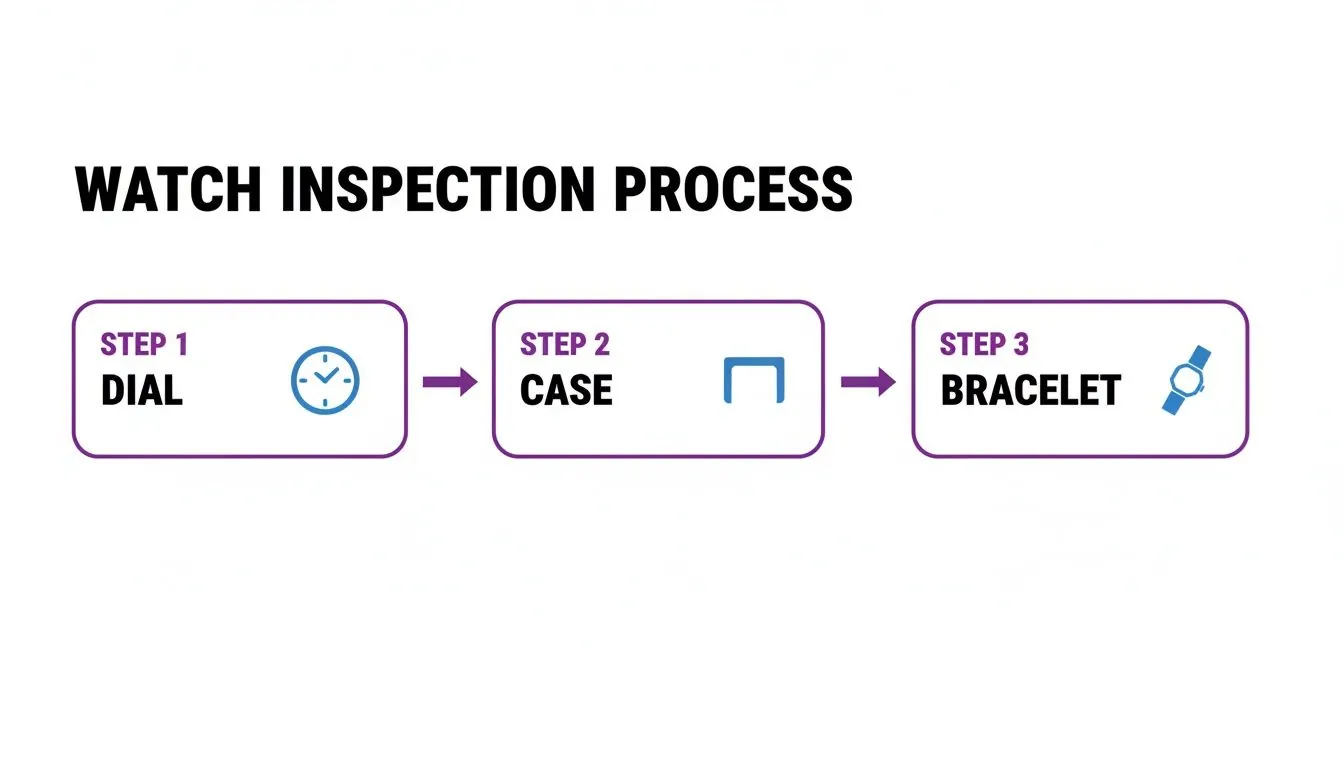 A diagram illustrating the watch inspection process, showing steps for the dial, case, and bracelet.
Authentication is all about stacking up these small details. A single inconsistency might be a fluke, but several together point straight to a fake.
A Look Through the Window
Many modern luxury watches come with a display caseback, giving you a direct window into the movement. This is where fakes have nowhere left to hide. Counterfeiters might get the general layout right, but they can never replicate the finishing.
When you peek through a genuine display back, you're looking at true horological art. Here's what you should see:
- Intricate Finishing: Look for beautiful decorative patterns like Côtes de Genève (Geneva stripes), perlage (circular graining), and polished, beveled edges on the bridges and plates.
- Blued Screws: Many high-end brands use thermally blued screws, which have a stunning, deep iridescent blue color. Fakes typically use cheap blue paint that looks flat and lifeless.
- A Decorated Rotor: The rotor (the oscillating weight that winds the watch) is almost always decorated with the brand’s logo or other detailed engravings.
In contrast, a counterfeit movement just looks raw and industrial. You’ll find plain stamped metal, rough edges, and an overall lack of care. It’s designed to fool you from a distance, but it completely falls apart under a loupe.
A genuine watch movement is finished to perfection, even on the parts you'll never see. A fake is only decorated where the forger thinks you might look. This difference in philosophy is the easiest way to tell them apart.
This skill is more important than ever, with some estimates suggesting that up to 30% of luxury watches sold online are counterfeits. That turns what should be an exciting purchase into a high-stakes gamble. Knowing that a genuine mechanical caliber like an ETA 2824 or an in-house Rolex 3135 ticks silently up to eight times per second, while a quartz fake often buzzes or jerks, is your best line of defense. You can learn more about the challenges in the luxury watch market to see why this level of diligence is so crucial.
Verifying Serial Numbers and Provenance
Now we move beyond what you can see and feel on the watch itself. This is where the detective work really begins. Every genuine luxury watch has a unique identity—its serial number. Think of it as the watch's fingerprint, a critical piece of data that unlocks its history and confirms if it’s the real deal.
A serial number isn’t just some random code; it's the manufacturer's direct link to that specific timepiece, telling a story of when and where it was born. Fakers can etch any old numbers onto a case, but they can't create a legitimate history to go with it.
Locating and Inspecting the Serial Number
First things first, you have to find the number. Its location can be a bit of a treasure hunt, as it varies between brands and even models. On a Rolex, you'll typically find it engraved between the lugs at the 6 o'clock position (you'll need to remove the bracelet for this) or etched on the inner bezel, called the rehaut. Omega often places it on the back of a lug or inside the caseback. For a deeper dive, check out our guide on how to find the serial number on your watch, and what it means when a serial number is missing, polished off or doesn't match the papers.
Once you've found it, get your jeweler's loupe out. The quality of the engraving says it all.
- Engraving Quality: A real serial number is a thing of beauty—laser-etched or machine-engraved with incredible precision. The lines are sharp, deep, and clean. Under magnification, they should reflect light like tiny diamonds.
- Font and Spacing: The font has to match the brand’s official style. Look for perfect alignment and even spacing between every single digit.
- Counterfeit Signs: Fakes often betray themselves here with crude stamping or acid-etching. This leaves the numbers looking shallow, fuzzy, or with a sort of "sandy" texture inside the lines. The spacing might be off, or the font will just look wrong.
A genuine serial number is a mark of industrial precision. A fake one is an approximation. If the engraving looks anything less than flawless under magnification, consider it a major red flag.
Checking the Number Against a Database
Finding the number is only half the job. Verifying it is where you can save yourself from a world of trouble. You need to confirm that the serial number matches the correct model and, crucially, that the watch hasn't been reported stolen. Believe me, stolen watches often surface in the same shady corners of the market as fakes.
This is why an online database is an absolutely essential tool in your due diligence. A service like StolenWatch lets you run a quick serial number search to see if the watch has been flagged as stolen anywhere in the world.
Here's what the search interface looks like on StolenWatch—simple and straightforward.
One quick search can tell you if the watch has a dirty past, potentially saving you from a disastrous purchase. A clean result, on the other hand, brings huge peace of mind.
For anyone serious about collecting or dealing, this check is non-negotiable. Authentic serial numbers are micro-engraved with laser precision, often only clearly visible under 10x magnification. Fakes, by contrast, have blurry or just plain incorrect engravings. This detail is critical, as stolen watches frequently mix with counterfeits on the secondary market, where an estimated 30% of online luxury watch sales are fakes. You can read more about the trends in the luxury watch market to understand why these checks are so important.
The Importance of Box and Papers
Finally, let's talk about "provenance"—the watch's documented history. A full set, which includes the original box, warranty card, and manuals (collectively known as "box and papers"), adds a ton of value and credibility.
But be careful. Just because a watch comes with papers doesn't automatically mean it's legit. The really good counterfeiters are now faking the documents, too.
Here’s what you need to scrutinize:
- Matching Numbers: The serial and model numbers on the warranty card must be an exact match to the numbers engraved on the watch. No exceptions. Any difference is an immediate deal-breaker.
- Print Quality: Real documents are printed on high-quality paper stock or plastic cards. The text is crisp and perfect. Fakes often feel cheap, the printing looks fuzzy, or you might even find spelling mistakes.
- Dealer Stamps: The warranty card should be stamped by an official, authorized dealer. You can often call a manufacturer's boutique to confirm if the dealer is legitimate.
What if the seller says the papers were lost? It happens, especially with vintage pieces, so it's not an automatic red flag. But it does mean the burden of proof shifts entirely onto the watch itself. In that case, checking the serial number in a database and getting a professional authentication becomes absolutely critical. It’s your only way to be sure you aren't buying a top-tier fake or a stolen watch with a sad story.
Spotting Red Flags in Online Listings
 A laptop displaying an online product page for a watch, with a magnifying glass highlighting text and a 'Red Flags' sticky note.
Buying a luxury watch online can feel like navigating a minefield. For every honest seller, there are dozens of scammers hoping to pass off a convincing fake as the real deal. Your best defense is a healthy dose of skepticism and a sharp eye for the little details that just don't add up.
Scammers play a psychological game. They create the illusion of an amazing deal to rush you into a bad decision, banking on excitement to cloud your judgment. Your job is to slow down, take emotion out of the equation, and dissect the listing piece by piece.
Analyzing the Listing Photos
The photos are your first and most crucial piece of evidence. This is where scammers often get lazy, sometimes using pictures that aren't even theirs. Be on high alert if you notice any of these tells.
- Stock Photos: If the pictures look like they were ripped straight from the brand’s official website or a magazine, walk away. A real seller will always use high-resolution photos of the actual watch they have in their hands, shot from multiple angles.
- Blurry or Low-Quality Images: Grainy, out-of-focus pictures aren't just unprofessional; they’re often an intentional trick to hide flaws like sloppy dial printing or poor case finishing. Demand crystal-clear, well-lit photos.
- Inconsistent Backgrounds: Do the photos of the dial, caseback, and bracelet look like they were taken in different places with different lighting? This is a huge red flag that the seller has cobbled together images from various sources to create a "franken-listing."
A trustworthy seller is proud of the watch they're selling and will happily provide plenty of clear, detailed photos. If they hesitate or refuse to send more pictures when you ask, that’s one of the biggest warning signs you can get.
Deconstructing the Description
After you've scrutinized the photos, the seller's words can be just as revealing. Vague, generic descriptions are a classic sign of someone who either doesn't know the watch or is actively trying to hide something. A true enthusiast or a reputable dealer knows the finer points of their timepiece and will be eager to share them.
Keep an eye out for these specific warning signs in the text:
- Vague Language: Phrases like "high-quality Swiss watch" without mentioning the specific model or reference number are a dead giveaway.
- Copied-and-Pasted Text: Does the description read like a generic marketing blurb you've seen elsewhere? It probably is.
- Excuses for Missing Items: The classic story is that the "box and papers were lost during a move." While it's possible, it’s also a convenient excuse used by sellers of fakes or even stolen watches. If papers are missing, you can check resources like this guide on the Stolen Rolex Watches Database to help verify a watch's history.
The global market is absolutely flooded with fakes—counterfeiting hits an estimated 40 million units a year, a number that dwarfs the entire legitimate pre-owned trade. These watches are built with junk parts and lack critical features, like the water resistance that authentic models are tested for. This massive scale makes your own vigilance essential.
Price and Payment Red Flags
Finally, it always comes down to the money. The price and the seller's payment policies are often the final tells that something isn't right.
If a deal seems too good to be true, it is. Period. Nobody is selling a genuine Rolex Submariner for $1,500. Scammers prey on greed.
You also need to be extremely wary of any seller who insists on irreversible payment methods, like a direct bank wire. Always use a secure platform with buyer protection. Think PayPal Goods & Services or a reputable escrow service that holds your money safely until you've received the watch and confirmed it's the real deal.
When to Seek Professional Authentication
<iframe width="100%" style="aspect-ratio: 16 / 9;" src="https://www.youtube.com/embed/XpOKV7NVfwA" frameborder="0" allow="autoplay; encrypted-media" allowfullscreen></iframe>Look, you can follow every step on a checklist, but sometimes you'll hit a wall. The truth is, the world of fakes is getting scarily good. We're talking about "super fakes" that can trip up even experienced collectors. These aren't the cheap knock-offs you find on a street corner; they use high-grade materials and meticulously cloned movements, making a simple at-home inspection feel like a guessing game.
This is the point where you need to tap out and pass the watch to a certified professional. For certain high-stakes deals, a DIY check just won't cut it.
When to Call in the Experts
Knowing your limits is one of the most important skills in this hobby. You absolutely need to bring in an expert in a few key situations:
- High-Value Purchases: If you’re about to drop serious money on a timepiece, the relatively small fee for professional authentication is non-negotiable. Think of it as insurance for your investment.
- Vintage Timepieces: Older watches are a minefield. They have long, often undocumented histories, and parts get replaced over the decades. An expert can tell the difference between a period-correct service part and a modern fake component.
- Suspected "Super Fakes": Ever have that nagging feeling? The watch ticks all the boxes, but your gut tells you something is just off. Trust that instinct. The most sophisticated fakes require a look under the hood.
A professional watchmaker does more than just glance at the watch; they inspect its soul—the movement. They can spot the microscopic differences in finishing and construction that separate a genuine caliber from a high-quality clone.
What to Expect During an Evaluation
A professional authentication is a world away from what you can do at your kitchen table. A certified watchmaker has the specialized tools and, more importantly, the skill to safely open the watch case. Please, never try this yourself. You risk damaging the delicate movement, ruining the water resistance, and instantly devaluing the watch.
Once inside, they're looking at the movement's architecture, the quality of the finishing on the bridges and plates, and the jewel count. They compare everything against the manufacturer's exact specifications, using high-magnification loupes and diagnostic tools to verify every last detail. This process gives you a verdict you can bank on. If you want to see why this matters so much, you can learn more about how certificate verification provides peace of mind for everyone involved.
Finding the right person is crucial. Your best bet is to start with an authorized dealer for that specific brand or search for watchmakers who are members of respected horological associations. For a reasonable fee, they'll give you the concrete answer you need to either walk away or buy with total confidence.
Got Questions? Let's Get Them Answered
Even after going through a detailed checklist, you're bound to have some specific questions pop up. It happens to everyone. Let's tackle some of the most common ones I hear from people trying to figure out if a watch is the real deal.
Do Real Luxury Watches Ever Use Quartz Movements?
You bet they do. It’s a common misconception that every high-end watch has to be mechanical. While brands built their legends on complex automatic and manual-wind movements, plenty of prestigious names like Omega, TAG Heuer, and Breitling offer fantastic, high-precision quartz models.
The trick is knowing what you're looking at. If you open up a Rolex Submariner and see a battery, you've got a problem. But a genuine quartz TAG Heuer will still feel solid, heavy, and beautifully finished—miles apart from a cheap knockoff.
What Exactly Is a "Super Fake" and How Do I Catch One?
Ah, the "super fake." These are the fakes that keep collectors up at night. We're talking about top-tier counterfeits built to be scarily accurate, sometimes using the same grade of steel and even featuring cloned mechanical movements. To the naked eye, they can be almost impossible to distinguish from the genuine article.
Honestly, spotting one often comes down to things an expert has to look for. The only sure-fire way is to have a professional watchmaker pop the caseback and examine the movement. The level of finishing on the internal components—the tiny, polished details you'd never normally see—is where the counterfeiters almost always cut corners. For these high-level fakes, solid provenance and a serial number check are absolutely non-negotiable.
With a potential super fake, your own inspection is just the starting point. The final call should always come from an expert who can see past the exterior and look at the watch's soul—the movement itself.
I Think I Bought a Fake Watch. Now What?
First off, don't panic. Take a deep breath and get organized. You need to document everything. Screenshot the original listing, save all your emails or messages with the seller, and have your payment receipts ready.
Next, get a second opinion. Take the watch to a trusted, reputable watchmaker and ask for a written statement confirming it's a counterfeit. This is your proof.
With that evidence in hand, reach out to the seller for a refund. If they ghost you or refuse, it's time to escalate. File a dispute with your credit card company or PayPal—their buyer protection policies are there for exactly this reason. And finally, make sure you report the seller to the marketplace (like eBay or Chrono24) to help prevent them from scamming someone else.
Checking a watch’s authenticity and its history is the most critical part of buying pre-owned. At StolenWatch, we've built a global database to give you the tools you need to check serial numbers, report a theft, and keep your collection safe. Before you buy, make sure your next watch has a clean history. Visit us at https://stolenwatchx.com.
Related Articles
View all
Your Guide to Watches Auctions Online and Spotting Fakes
Master watches auctions online with our expert guide. Learn to spot fakes, verify authenticity, and get the best deals on luxury timepieces.
Serial Number on a Watch: Missing, Polished Off or Not Matching?
What to do when the serial number on a watch is missing, worn, polished off or different from the papers, and how to record a readable serial before theft.
How to Obtain a Certificate of Authenticity for a Watch
Learn how to obtain a certificate of authenticity for a watch, what documents matter, and why a stolen-watch check should come before any certificate request.