The Ultimate Stolen Rolex Watches Database Guide
Explore our guide to using a stolen Rolex watches database. Learn how to protect your assets, report theft, and recover your luxury timepiece.
StolenWatch Team
Watch Authentication Specialist at StolenWatch
Explore our guide to using a stolen Rolex watches database. Learn how to protect your assets, report theft, and recover your luxury timepiece.
A stolen Rolex database holds reports of watches described as lost or stolen. Buyers can search for matching records, while owners can submit the details of a missing watch. If your Rolex was stolen, submit a free stolen watch report. Enter the details you know; the serial number and police document are optional for submission and can be added later. A report does not guarantee recovery or establish ownership.
It's the first place anyone should check before buying or selling a pre-owned watch, giving them a clear look into its history. See our stolen Rolex database check to search a Rolex specifically, or the general watch serial number lookup for any other brand.
Submit Your Stolen Watch Report
Start your free stolen watch report when you have the watch brand and model or reference, the loss date and a description of what happened. The form also asks for your contact details so you can be reached about your report.
Add the serial number and supporting photographs if you have them. If the serial is missing, leave it blank rather than guessing. A police document is optional for submission; you can add it later through your account or support. Basic reporting is free, and premium tracking is optional.
Keep the report accurate as new information becomes available. Add verified identifiers and documents, and update the watch status if it is recovered. Reporting helps others review possible matches; it does not guarantee recovery.
Why a Stolen Rolex Database Is So Important Today
Owning a beautiful timepiece should be a simple joy, but the reality is that high-end watches—especially a brand like Rolex—are a magnet for theft. This isn't just a minor inconvenience; it's a massive, growing problem that puts everyone from individual owners to seasoned dealers at risk. Now more than ever, a reliable and accessible stolen Rolex database is an absolute necessity.
The concept is a lot like the VIN system for cars. Every vehicle has a unique Vehicle Identification Number (VIN) that tracks its entire history, from ownership changes to accidents. If a car is stolen, its VIN is flagged in a national database, instantly alerting police and potential buyers. A stolen watch database does the exact same thing for horology.
Every Rolex has a unique serial number—its own distinct fingerprint. By registering that number in a database if the watch is stolen, we create a digital tripwire that can stop a thief in their tracks.
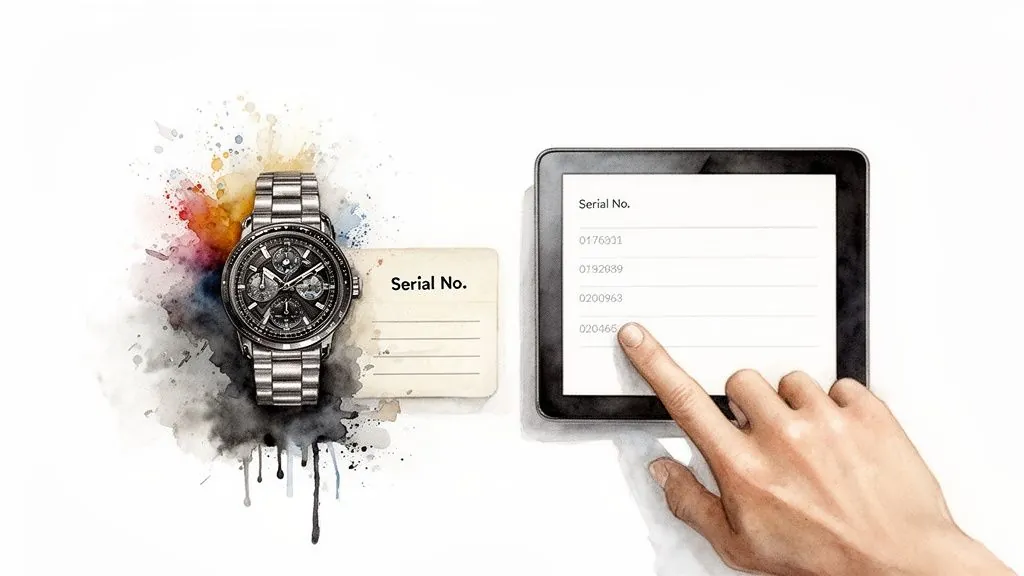 A watercolor illustration of a watch, a 'Serial No.' card, and a hand touching a tablet listing serial numbers.
The clear, direct interface seen on platforms like StolenWatch highlights its dual purpose: it helps owners in their recovery efforts while empowering buyers to make safe, informed decisions.
The Shocking Rise in Watch Theft
The scale of this problem has exploded. We're talking about a global epidemic where over £1 billion ($1.3 billion) worth of watches were reported stolen in 2022 alone. One leading registry, The Watch Register, tracked nearly 80,000 lost or stolen timepieces that year—a jaw-dropping 60% increase from 2021. You can dig into the specifics in the full report on watch theft trends. This surge shows just how vulnerable the market is when there isn't a system in place to fight back.
Without a central database, a stolen watch can be sold and resold, often ending up thousands of miles from where the crime occurred. An honest buyer could unknowingly purchase stolen property, and the consequences are severe:
- Total Financial Loss: Law enforcement can (and will) confiscate the watch, leaving the new buyer out of pocket with nothing to show for it.
- Legal Headaches: The buyer may be pulled into a legal battle to prove they had no idea the watch was stolen.
- Fueling Crime: Every successful sale of a stolen watch just encourages and funds more criminal activity.
Closing the Loophole for Thieves
This is where a stolen Rolex database becomes the industry's first line of defense. It introduces a level of transparency and accountability that simply didn't exist before. When a reputable dealer, pawnbroker, or even a private collector is offered a pre-owned Rolex, a quick search of the serial number can immediately flag it as stolen.
This simple step—a quick, pre-purchase check—is a game-changer. It transforms the pre-owned market from a place of high risk and uncertainty into a much safer, more trustworthy environment.
Ultimately, it shrinks the marketplace for criminals, making it far more difficult for them to profit from their crimes. This collective vigilance is what makes these databases so powerful. It’s not just about one person hoping to get their watch back; it’s about the entire community working together to protect the integrity of the hobby we all love. Every search, and every report filed, strengthens this protective network for everyone.
How a Stolen Watch Database Actually Works
Think of a stolen watch database as a global neighborhood watch for high-end timepieces. It’s a shared intelligence system designed to protect the entire community of watch lovers. When a Rolex is stolen, it doesn't just disappear—it gets funneled into a shadowy grey market. A good database acts like a digital tripwire, alerting honest dealers, buyers, and authorities the second that watch pops up for sale again.
It all starts the moment an owner reports their watch stolen. By entering the timepiece's unique serial number into a registry, they create a permanent, searchable record of the theft. This one simple action turns a private loss into a public alert that professionals across the world can see. That serial number is the watch’s fingerprint; it's the one identifier that can't be easily changed without leaving obvious, tell-tale signs of tampering.
This initial report is the bedrock of the entire recovery system. Without it, a stolen watch can be sold and resold to unsuspecting buyers, perpetuating the cycle and making recovery nearly impossible.
The Key Players and Their Roles
For a stolen Rolex database to be effective, it needs active participation from a few key groups. Each one has a specific, yet connected, role to play. It's truly a collaborative effort where every check and report strengthens the entire network.
- The Owner: The owner is the first responder. They need to file a police report and register the watch's serial number immediately. This is what officially sounds the alarm and provides the critical data needed to flag the watch.
- The Dealer or Jeweler: Reputable dealers are the gatekeepers of the pre-owned market. Before they even think about buying a watch for their inventory, they run the serial number through a database. If it gets a "hit," the transaction stops dead in its tracks.
- The Pawnbroker: Pawnbrokers are often the first stop for thieves trying to get quick cash. By searching serial numbers, they can avoid taking in stolen property and can tip off law enforcement to potential criminals.
- The Insurance Company: Insurers rely on these databases to validate theft claims. When a client reports a watch stolen, the insurer can see if it's been properly registered, which helps process the claim and supports recovery efforts.
- Law Enforcement: Police departments use the data to spot theft patterns, link cases together, and recover stolen goods. When a flagged watch is found during an investigation, the database report helps trace it right back to its original owner.
From Report to Recovery: The Digital Journey
Once a Rolex is registered as stolen, its serial number essentially becomes a red flag across the global market.
Let’s say a dealer in another country is offered that exact watch. As part of their standard procedure, they'll do a quick serial number search. The moment they type it in, the database flags the item as stolen property and shows them the details from the original report.
This is the critical intercept point. The database transforms a simple serial number lookup from a routine check into a powerful anti-crime tool, effectively halting the illegal sale in its tracks.
This system makes it incredibly difficult for thieves to cash in. They can no longer count on time or distance to hide a watch's shady history. You can even search for a watch's status yourself to see just how simple and effective this verification process is.
From there, the database helps connect the dots—linking the person who found the watch with the original owner and the police. It provides the crucial information needed to verify ownership with the police report and kick off the legal process of getting the timepiece back home. It's this coordinated response that makes a stolen watch database an absolutely essential tool for the watch community.
Your Step-By-Step Guide to Reporting a Stolen Rolex
The moment you realize your Rolex is gone is a gut-wrenching experience. It's a mix of shock, violation, and panic, and it’s easy to feel helpless. But what you do in those first few hours is absolutely critical. Taking swift, calculated action can dramatically increase your chances of seeing that watch again.
This guide will walk you through the exact steps to take, turning that initial wave of panic into a focused, proactive recovery plan. Time is not on your side, so let’s get started.
First and Most Critical Step: File a Police Report
Before you do anything else, call your local police and file an official report. I can't stress this enough—this isn't just a suggestion; it's the non-negotiable first step. Without an official police report, you have no legal ground to stand on if your watch is recovered.
When you speak with the officer, provide every detail you can. Give them the serial number, model, a full description, and the circumstances of the theft. The most important thing you'll walk away with is the official case number. This number is the key that unlocks everything else, from insurance claims to registering the watch as stolen.
A police report is what formally documents the crime. It gives pawn shops, dealers, and other law enforcement agencies the authority to seize your watch if it surfaces. It elevates your personal loss into an official criminal investigation.
Next: Gather Your Essential Information
With the police report filed, it's time to build a complete file for your stolen watch. Think of it as creating a "missing persons" report for your Rolex. The more specific the details, the higher the chance of a positive identification.
To give your report the best chance of success, you'll need a few key pieces of information. The table below outlines what to gather, why it matters, and where you can usually find it.
Essential Information for Reporting a Stolen Watch
| Information Category | Why It Is Critical | Where to Find It |
|---|---|---|
| Serial Number | This is the watch's unique DNA. No two are the same, making it the single most important identifier. | Engraved on the watch case (between the lugs or on the inner rehaut), warranty card, and original sales receipt. |
| Model Number & Name | Narrows down the search. For example, "Submariner Date, Ref. 126610LN." | Warranty card, appraisal documents, and original purchase paperwork. |
| Purchase Documents | This proves ownership and establishes the watch's provenance and value for both police and insurance. | Sales receipt, warranty card, certificate of authenticity, and any service records. |
| Detailed Photographs | A picture is worth a thousand words. Clear photos help dealers and collectors visually confirm a match. | Your phone's camera roll, social media posts, or photos from when you first bought it. |
| Unique Markings | Any custom engravings, dings, or distinctive scratches make your specific watch stand out from others. | Your own memory or close-up photos you may have taken. |
| Police Report Number | This links your database entry directly to the official law enforcement investigation, adding legal weight. | The copy of the police report provided by the law enforcement agency. |
Having this dossier ready makes the next steps far more effective and shows everyone involved that you are serious about recovery.
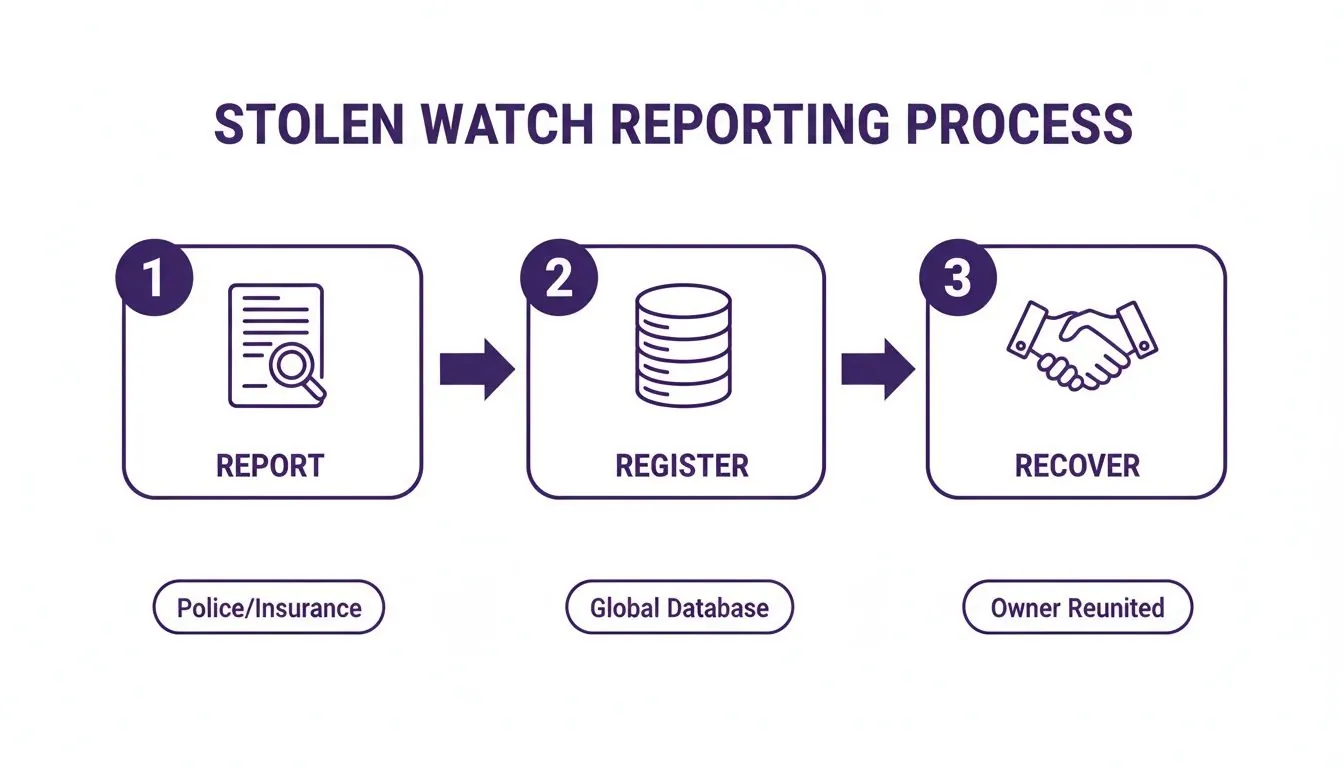 Infographic detailing the stolen watch reporting process: Report, Register, and Recover.
This three-step process—Report, Register, Recover—is the proven playbook for owners fighting to get their property back.
Register Your Watch on a Global Database
A police report is vital, but its reach is often local. To truly put the word out, you need to alert the global watch community. This is where a dedicated stolen watch database becomes your most powerful tool.
When you report a stolen watch on our platform, you’re not just filling out a form. You are creating a digital "be on the lookout" alert that goes live for thousands of dealers, auction houses, pawnbrokers, and collectors around the world.
If your watch shows up for sale in New York, London, or Hong Kong, a simple serial number search will instantly flag it as stolen property. This simple action poisons the well for the thief, making it incredibly difficult for them to offload the watch for a profit. You’re essentially deputizing the entire industry to be your eyes and ears, creating a powerful network against theft.
How to Safely Buy a Pre-Owned Rolex
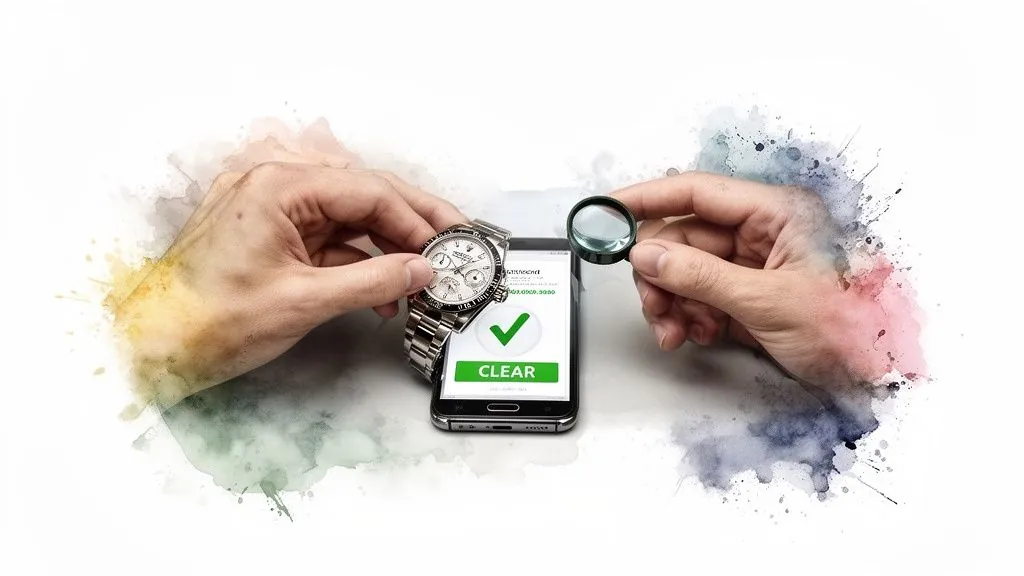 Hands verifying a Rolex watch with a smartphone and magnifying glass, showing 'CLEAR' status.
Diving into the pre-owned Rolex market is a thrill. It's a world filled with rare, discontinued, and classic models you just can't find in a boutique. But let's be honest—it’s not without its risks. The biggest landmine you can step on is accidentally buying a stolen watch, a mistake that can wipe out your investment and land you in a world of legal trouble.
This is where a little bit of smart homework pays off big time. Using a stolen Rolex watches database is the single most powerful tool you have. It turns a potentially risky gamble into a safe, transparent transaction and gives you complete peace of mind.
Think of it as the final, critical checkpoint before any money changes hands. It’s the moment you confirm the watch’s history is as clean as its polished steel, ensuring your new prized possession brings joy, not headaches.
Your Pre-Purchase Verification Checklist
Before you even think about finalizing a deal, you need to do your due diligence. It all starts with one simple request: ask the seller for the watch's serial number. Any legitimate seller with nothing to hide will share it without a second thought.
With the serial number in hand, your next move is to run it through a comprehensive stolen watch database. This is usually a quick, straightforward process that gives you an immediate answer on whether the watch has been reported lost or stolen.
A "clear" result is your green light to proceed. A "flagged" result, however, is an absolute, non-negotiable red flag. It means you stop the transaction immediately.
Understanding the search result is simple:
- Clear Result: The serial number isn't listed in the database as stolen. This is great news and a strong signal that you can move forward, assuming everything else about the watch checks out.
- Flagged Result: The serial number matches a stolen watch report. Do not buy the watch. No matter how good the deal seems, just thank the seller for their time and walk away.
Identifying Red Flags and Warning Signs
Beyond the database check, you need to trust your gut. Experienced buyers learn to spot the behavioral and circumstantial clues that scream "something is wrong." Criminals are often in a hurry to sell and can be cagey about details, but their tactics are easy to spot if you know what to look for.
Be on high alert if you encounter any of these warning signs.
Common Red Flags When Buying a Rolex:
- Refusal to Share the Serial Number: This is the biggest red flag, period. A seller who won't give you the serial number is almost certainly hiding something. There is no good reason to withhold it from a serious buyer.
- Price Is Too Good to Be True: Luxury watches hold their value incredibly well. If you see a Rolex offered for a price that's far below the going market rate, it’s a massive warning. It usually means the seller needs to offload it fast and quietly.
- Missing Box and Papers: While it's not always a deal-breaker for older vintage pieces, a modern Rolex being sold without its original box, warranty card, and receipts is cause for concern. These items are the backbone of a watch's provenance.
- Pressure to Make a Quick Decision: Scammers love to create a false sense of urgency. They’ll push you to buy right now, before you have a chance to do your homework. A real seller will respect your need to be careful.
- Vague or Inconsistent History: If the seller’s story about where they got the watch feels fuzzy, or if the details keep changing, it’s time to be skeptical. A clean watch comes with a clear history.
By making a serial number check mandatory and keeping a sharp eye out for these red flags, you can navigate the pre-owned market like a pro. This two-pronged approach ensures your investment is solid, your purchase is ethical, and your new timepiece is something you can be proud to wear—free of any tainted history.
When your Rolex is stolen, the feeling is intensely personal and isolating. But the moment you add its serial number to a stolen watch database, you're no longer alone. You’ve just tapped into a vast, interconnected network working to get it back.
Think of this network as a powerful alliance between owners, insurance companies, and law enforcement. The database acts as the central hub, the a crucial communication channel connecting everyone. Your report isn’t just a cry for help; it's a vital piece of intelligence that strengthens the entire system, making the pre-owned market a much harder place for thieves to operate.
How Insurers Use the Database
Insurance companies are a major player in this recovery effort. For them, a robust database is a front-line tool for sniffing out fraud and recovering stolen assets. When you file a claim for a high-value watch, one of the first things your insurer will likely do is check if the watch has been registered as stolen—both with the police and in a database like ours.
This simple check accomplishes a few important things:
- Validating the Claim: It helps confirm that a genuine theft occurred, which speeds up the process for legitimate claims.
- Recovering the Asset: After an insurer pays out a claim, they often assume ownership of the stolen watch. They then use the database to keep an eye on the market, hoping to recover the watch and offset their financial loss.
- Assessing Risk: Over time, the data gathered from thousands of thefts helps insurers spot patterns. This informs their policies and allows them to offer better security advice to all their clients.
Insurers aren't just passively processing paperwork. They are active partners in a system designed to choke the resale market for stolen watches, which is a win for every watch owner.
The Critical Role of Law Enforcement
Filing a police report is always the first, non-negotiable step. But police departments are often limited by jurisdiction. A watch stolen in Paris is nearly impossible for police in New York to track on their own. This is where a global stolen watch database changes the game, acting as an international intelligence tool.
Imagine officers raid a location and find a cache of stolen watches. They can run the serial numbers through the database in minutes. A match instantly links a recovered watch back to its owner and the original police report, no matter where in the world the theft occurred. It’s a direct line to returning property and building a stronger case for prosecution. You can learn more about our collaboration with law enforcement agencies and how it helps them get results.
This shared intelligence helps police connect the dots on organized crime. By linking thefts across cities and countries, they can move beyond individual incidents and start building cases against the sophisticated criminal rings behind them.
A Symbiotic Relationship for Recovery
The real magic of this ecosystem is how all the pieces fit together. Each group provides something the others need, creating a powerful cycle of information that dramatically increases the odds of getting a watch back.
It starts with the owner's report. Insurers use that report to validate claims and fund the recovery ecosystem. Law enforcement uses the collective data to track criminals and retrieve stolen property. And finally, conscientious dealers and pawnbrokers use the database to vet their inventory, often providing the tip that cracks the case.
This teamwork gets real results. According to The Watch Register, a staggering 50% of recovered watches are found within one year of the theft, and an impressive 35% are located in just the first six months. They report identifying about five stolen watches every single day through their network.
These numbers prove it: registering your stolen watch isn't just a passive act. It's a powerful move that plugs you into a global fight against crime and gives your timepiece a real chance of coming home.
Common Questions About Stolen Watch Databases
Even after you understand how a stolen Rolex database works, a lot of real-world questions pop up. It's one thing to know the theory, but it's another to be in the middle of a stressful theft or trying to do your homework before a big purchase. You need clear, straightforward answers.
Think of this section as your practical field guide. We're going to tackle the common "what if" scenarios head-on, from dealing with missing paperwork to figuring out what happens when your stolen watch surfaces on the other side of the planet. My goal is to give you actionable advice that builds on everything we've covered so far.
These are the nuts-and-bolts questions that can mean the difference between a dead end and a successful recovery.
What Should I Do if I Cannot Find My Rolex Serial Number?
This happens more often than you'd think, and it’s definitely a stressful moment. But don't panic—you still have options. The serial number is the single most important key to unlocking a recovery, so your first priority is to exhaust every single possibility to find it.
Start by digging through all your original purchase documents. The serial number is almost always printed on the warranty card, the sales receipt, and any appraisal paperwork. These papers are your best friends right now. If you bought the watch from an authorized dealer, call them immediately. They often keep meticulous sales records and might just have the serial number on file for you.
If you come up empty-handed, you can still file a report, but it gets a bit tougher. Here's what you can do:
- Provide the Model Number: It’s not unique, but it at least narrows the search field.
- Share Detailed Photos: Good, clear pictures can be surprisingly helpful for visual identification down the line.
- List Unique Markings: Note any custom engravings, specific scratches, or tiny dings that make your watch your watch.
You can submit a free stolen watch report without a serial number. Leave that field blank, include the reliable model and loss details you have, and add the serial later through your account or support. A serial number helps distinguish possible matches, but does not by itself establish ownership or guarantee recovery.
Is It Free to Register a Stolen Watch on a Database?
That's a great question, and the answer is: it depends. Different platforms have different business models, so it pays to check their specific policies before you start.
Some registries, like ours, believe in making registration free for individual owners. The thinking here is simple: a database is only as strong as the data it holds. By removing any cost, we encourage more victims to report their stolen watches, which strengthens the entire network for everyone and makes it much harder for thieves to sell their stolen goods.
Other services might charge a one-time fee to list your watch or offer premium tiers with extra features. These could include proactive recovery assistance or direct alerts to a global network of dealers. When you're talking about a luxury timepiece worth thousands, a small fee can be a very worthwhile investment for a better chance at getting it back.
How Does a Database Help if My Watch Is Sold Internationally?
This is where a global stolen Rolex watches database really shines. A local police report is absolutely critical, but let's be honest, its reach stops at the border. A digital, global database has no such limits.
Picture this: your watch is stolen in Paris and smuggled to a buyer in Hong Kong. Here’s how the database creates a worldwide safety net:
- A Global Alert: The moment you report it, the serial number is flagged for any professional who searches for it, no matter where they are.
- Due Diligence Checks: A reputable dealer in Hong Kong, as part of their standard intake process, runs the serial number before agreeing to buy the watch.
- The Transaction Stops: The database search instantly returns a "stolen" status. The sale is dead in the water, and the thief can't cash in.
This digital tripwire works across borders, making it incredibly difficult for criminals to launder stolen watches through the legitimate pre-owned market, no matter how far they travel.
What Happens After My Stolen Watch Is Found?
This is the moment every owner dreams of. When your watch is identified—whether by a sharp-eyed pawnbroker, an honest dealer, or a diligent auction house—the recovery process officially kicks off. The database acts as the essential communication hub connecting all the dots.
Typically, the platform will help connect the person who found the watch, you (the rightful owner), and the relevant law enforcement agency. This is where your original police report becomes absolutely vital, as it serves as the legal proof of ownership you'll need to reclaim your property.
Think of the database service as the intermediary. It provides the verified information and contact points needed to get the legal and logistical process of returning the watch started. It closes the gap between discovery and recovery.
StolenWatch is built to be that central hub, offering a free and open platform for the entire watch community. By making it simple to report a loss and easy to search a serial number, we empower owners, dealers, and law enforcement to work together against theft. Protect your collection and contribute to a safer market by learning more at https://stolenwatchx.com.
Related Articles
View all
How Can I Check My Rolex Serial Number A Definitive Guide
Wondering how can I check my Rolex serial number? This guide details how to locate and decode your number to verify age, authenticity, and ownership history.
A Practical Guide to Your Watch Serial Number Check
Use this comprehensive guide to perform a watch serial number check. Learn to verify authenticity, identify fakes, and protect your luxury watch investment.
Rolex Watch Lookup: Check Serial Number and Theft
Run a Rolex watch lookup by finding the serial number, checking theft databases, and verifying authenticity before you buy, sell, or insure.