A Practical Guide to Your Watch Serial Number Check
Use this comprehensive guide to perform a watch serial number check. Learn to verify authenticity, identify fakes, and protect your luxury watch investment.
StolenWatch Team
Watch Authentication Specialist at StolenWatch
Use this comprehensive guide to perform a watch serial number check. Learn to verify authenticity, identify fakes, and protect your luxury watch investment.
A watch serial number check is probably the single most important thing you can do to verify a pre-owned timepiece. It's all about taking that unique ID number from the watch and running it against known databases to make sure it hasn't been reported stolen and isn't a known fake. Honestly, this simple step is your best line of defense in a market that can be pretty risky. Our watch serial number lookup hub covers where to find the number by brand and lets you run the check directly.
Why You Can't Afford to Skip a Serial Number Check
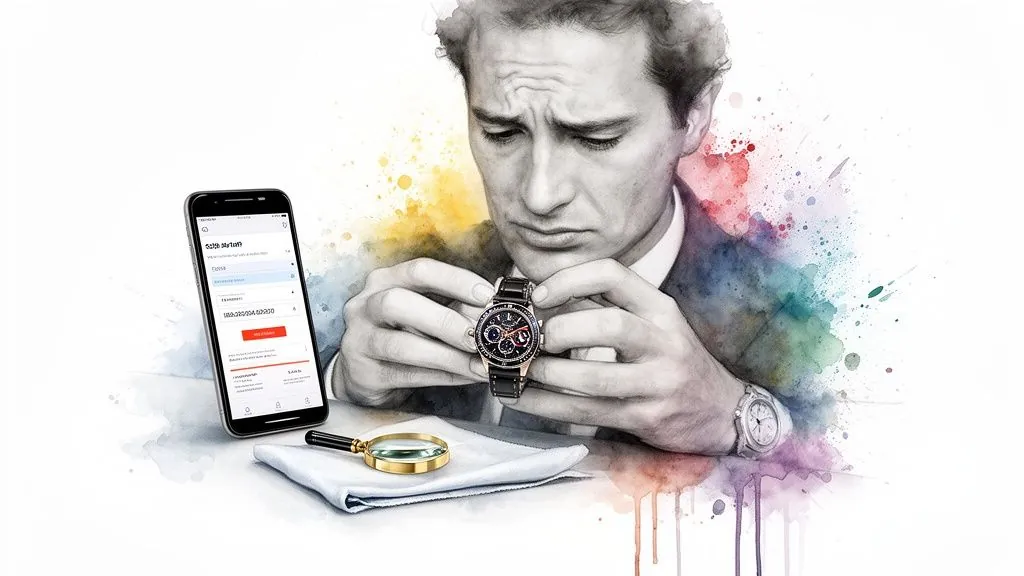 A man intently examines a watch with a magnifying glass, next to a smartphone displaying a serial number check.
When you're dealing with pre-owned luxury watches, what you don't know can absolutely come back to bite you. The market is flooded with incredibly sophisticated fakes and, unfortunately, a lot of stolen timepieces. That serial number is your most powerful tool for due diligence. Think of it as the watch's DNA—it holds the key to its history, its authenticity, and its legitimacy.
Skipping this check is like buying a used car without even glancing at the title or a vehicle history report. It’s a huge gamble, and it rarely pays off. A quick search can reveal a watch's hidden story, protecting you from a major financial hit and even potential legal trouble down the road.
The Alarming Rise in Watch Crime
The pre-owned watch market is hotter than ever, but so is the crime that comes with it. To give you an idea, The Watch Register, a massive global database for stolen watches, now tracks timepieces valued at a staggering £1.5 billion.
Just last year, they saw a 236% increase in unique serial numbers being added to their system. That’s a clear sign of a global surge in watch theft. This data, which you can read more about on GDN Life, underscores why having a central, accessible database like StolenWatch is so critical. It helps protect everyone—from individual buyers to established dealers—from accidentally getting involved with stolen property.
A serial number check isn't just a "nice-to-have" anymore; it's a fundamental part of responsible watch ownership and trading. It shifts a purchase from a risky act of faith to a confident, informed investment.
It's More Than Just a Theft Check
While catching stolen watches is a huge part of it, a serial number check does a lot more. It's a powerful verification tool that helps you in a few key ways.
- Confirm Authenticity: This is a big one. Counterfeiters often get lazy and use real serial numbers, but they might be from a different model or year. A quick check can flag a number that just doesn't line up with the watch's supposed production era or specific model details.
- Establish Provenance: The number can help you piece together a watch's history, which adds to its story and, often, its value. A clean record from a reputable registry boosts a seller's credibility and gives a buyer peace of mind.
- Protect Your Investment: It’s simple: a watch with a clean, verifiable history will always be worth more and will be much easier to sell when the time comes.
At the end of the day, running a watch serial number check is just a smart, proactive move. It gives you the power to buy, sell, and collect with the confidence that your watch is legitimate, securing both your money and your peace of mind.
Finding the Serial Number on Your Timepiece
The first hurdle in checking a watch's history is often the simplest: actually finding its serial number. This unique string of digits is the key to unlocking a watch's past, but manufacturers don't always put it in an obvious place. Knowing where to look is the first real step in doing your homework properly.
Most of the time, you'll find it engraved on the case back, often right next to the model or reference number. But sometimes, especially with older or more refined pieces, makers hide it to keep the watch's lines clean. In those cases, you might need a special tool—or even a trip to a watchmaker—to reveal it without causing damage.
Pinpointing the Location on Top Brands
Every brand has its quirks and traditions when it comes to placing serial numbers. A little inside knowledge can save you a lot of time and prevent an accidental scratch.
Take Rolex, for example. For decades, they engraved the serial number on the case itself, hidden between the lugs at the 6 o'clock position. You can only see it by carefully removing the bracelet. If you've never done this before, I'd strongly suggest letting a professional handle it to avoid marking up the lugs.
Starting around 2005, Rolex began engraving the number on the rehaut—that's the inner metal ring between the dial and the crystal. By 2008, this became the standard spot, making the number much easier to see at a glance.
To help you get started, here's a quick reference guide for finding the serial number on some of the most popular luxury watch brands.
| Brand | Primary Location | Secondary Location(s) |
|---|---|---|
| Rolex | Rehaut (inner bezel ring, post-2008) | Between the lugs at 6 o'clock (pre-2008) |
| Omega | Case back exterior or on one of the lugs | Engraved on the movement (common on vintage models) |
| Patek Philippe | Engraved directly on the movement | Inside the case back (on solid-back models) |
| Audemars Piguet | Engraved on the case back | N/A |
| Cartier | Case back exterior | N/A |
| Breitling | Case back exterior | Between the lugs (some older models) |
Keep in mind this is a general guide. Models, especially vintage ones, can have exceptions, so it sometimes takes a bit of detective work.
Tools and Techniques for a Clear View
After years of wear, these engravings can become faint and hard to read. Getting a crystal-clear look is non-negotiable for an accurate check.
Don't just rely on your naked eye. A misread digit can send you on a wild goose chase. The right tool can be the difference between a confident "all clear" and a very expensive mistake.
A jeweler's loupe with 10x magnification is the gold standard for a reason. It lets you see the engraving's depth and sharpness clearly. In a pinch, your smartphone can do a decent job. Just switch to macro mode or use the zoom function with bright, direct light. Snap a high-resolution photo, then zoom in on the image to inspect the number.
For a deeper dive into finding these crucial identifiers, you can learn where the serial number is on each brand, or read what to do when a watch serial number is missing or doesn't match the papers.
What to Do When Numbers Look Wrong
Sometimes, what you don't find is the biggest clue. A missing, altered, or heavily polished serial number is a massive red flag. This often means the watch was stolen, and someone tried to scrub its identity clean.
Pay close attention to the engraving quality. If it looks shallow, uneven, or has a strange "dotted" texture, you might be looking at a fake. Authentic engravings from major brands are typically deep, crisp, and precise. Trust your instincts. If anything about the number's appearance or location feels off, it's time to walk away and get an expert's opinion.
Diving In: How to Properly Vet a Watch Serial Number
Alright, you've got the serial number. Now the real work begins. This isn't about just one quick search; it's about layering your checks to build a solid, trustworthy picture of the watch's history. A methodical approach here is your best defense against making a very expensive mistake.
The first, and frankly most important, check is running that number through a dedicated stolen watch registry. I always start with a platform like StolenWatch. It’s designed for this exact purpose and gives you an immediate first pass against a global database of reported thefts. This one search can instantly tell you if the watch is hot, saving you from a world of trouble.
Your First Move: The Global Database Check
Think of this as the essential background check for your watch. It’s the fastest, most efficient way to see if any red flags have been raised by owners, retailers, or even law enforcement.
Just punch the full serial number into the search field. What you're hoping for is a clear "no records found" or "clean" report. This means the number hasn't been flagged as stolen within that specific database.
A clean report from a global registry is a fantastic starting point, but it's not the final word. A watch could have been stolen too recently to be reported, or the owner might not have known where to register it. True due diligence means digging deeper.
If you get a hit? It's simple: stop everything. Don't buy the watch. If you're already holding it, your next call should be to your local police department for guidance. Getting tangled up with stolen property is a mess of legal and financial problems you want no part of.
First, you have to find the number. The infographic below shows the three most common spots.
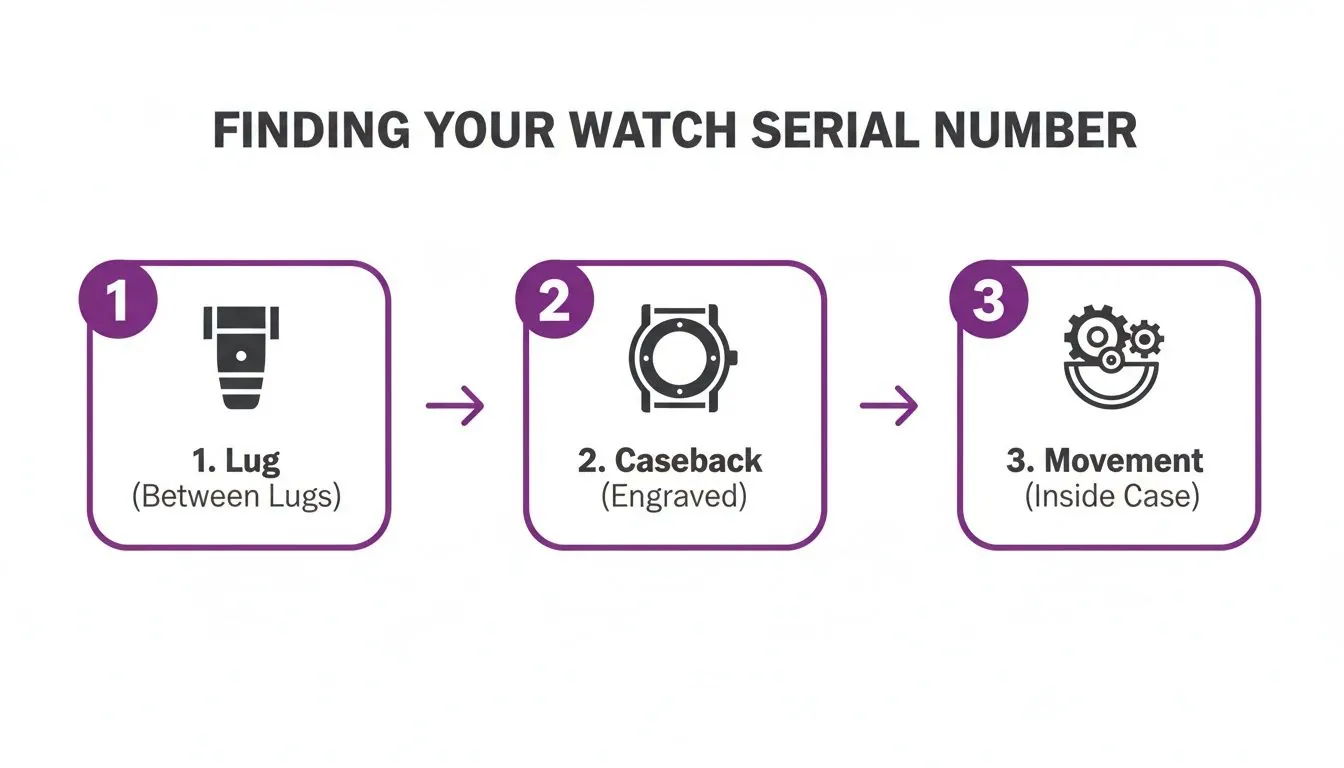 A step-by-step guide illustrating three places to find a watch serial number.
As you can see, you'll typically find it tucked between the lugs (where the bracelet attaches), etched onto the case back, or sometimes engraved directly on the movement inside.
Next Up: Cross-Reference with Brand Archives
Once you've cleared the stolen database, it's time to play detective. Your next move is to check the serial number against what's known about the brand's production history. Big names like Rolex and Cartier have well-documented serial number ranges that correspond to specific manufacturing years.
For example, I once looked at a Rolex with a "U" prefix in its serial, which immediately told me it was from around 1997. The seller was claiming it was a 2005 model. That’s a massive red flag. This kind of mismatch can point to a counterfeit, or what we call a "Frankenwatch"—a timepiece cobbled together from various mismatched parts.
You can find this data on collector forums and dedicated watch resource sites. Just search for something like "[Brand Name] serial number dating chart."
- Does the year match up? The serial number should align with the watch's claimed production date.
- Is it the right model? Certain serial ranges were used for specific models. Make sure they're consistent.
- Trust your gut. If a detail feels off, it probably is.
This step is about validating the watch's identity beyond its theft status. It's a non-negotiable part of any serious watch serial number check.
The Final Confirmation: Go Straight to the Source
For a high-value piece or a rare vintage find, I always recommend making one last call: to the manufacturer's service center. Brands can be secretive about their records for privacy reasons, but they can often confirm if a serial number is legitimate and matches the model you're looking at.
When you reach out, have this ready:
- The full, clear serial number.
- The watch's model or reference number.
- Good, clear photos of the watch (front, back, and a close-up of the serial if you can get one).
Simply ask if they can confirm the serial number corresponds to the watch model and its original configuration. Sometimes, they might even know if it was reported stolen directly to them—a detail that might not show up on a public registry. For more on how this works with specific brands, our guide on the stolen Rolex watches database offers some great insights.
Finally, document every step. Keep screenshots of your database searches, jot down notes from your calls, and save links to the dating charts you used. This paper trail is your proof that you did your homework and is your best protection in any transaction.
What the Results Mean and How to Spot Red Flags
Running a serial number check is just the start—the real art is in knowing how to read the results. What you find will usually fall into one of three buckets, each telling a very different story about the watch in question. Learning to decode these outcomes is your best defense.
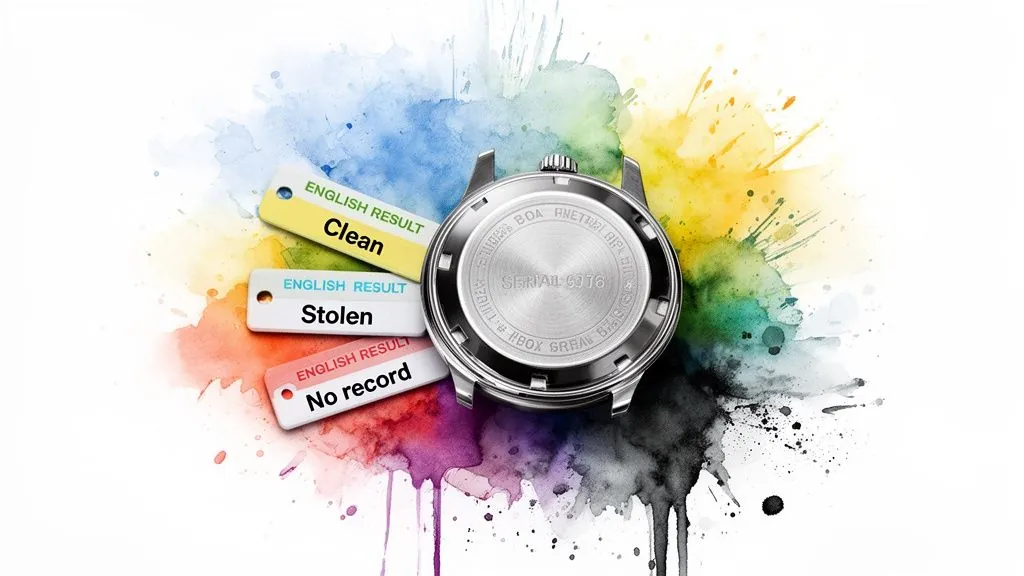 A watch back with serial number 6076 and three tags showing 'Clean', 'Stolen', 'No record' results.
A "Clean" or "No Records Found" result is obviously what you want to see. This indicates the serial number hasn't been flagged as stolen, lost, or counterfeit in that particular database. It’s a great sign, but it’s not a complete all-clear just yet. Think of it as an essential green light, not the only one you need.
On the flip side, an immediate "Stolen" flag is a hard stop. If the number pops up in a stolen watch registry, the deal is off. Do not proceed. You could be acquiring stolen property, and that comes with a whole host of legal and financial headaches you don't want.
When No Record Is Found
Getting a "no record found" message is good news, but it isn’t an ironclad guarantee of legitimacy. It just means the watch hasn’t been reported to the specific database you're using. There are a few reasons why this might happen:
- The theft just happened: The owner may not have had a chance to report it yet.
- It was never reported: Some owners don't know about services like StolenWatch or may simply not file a report after a loss.
- Database limitations: No single database is all-encompassing. While they are incredibly thorough, they can't possibly contain every stolen watch report from every corner of the globe.
This is exactly why a clean database check should be one part of a larger verification process. You should also be cross-referencing the serial number against the watch's known production history. This is where you can learn about the hidden value of watches by serial number and use that knowledge to build a more complete picture.
Subtle Clues and Critical Red Flags
Beyond the database search, you have to train your eye to catch the small inconsistencies that often betray a problem. Counterfeiters are getting scarily good, and one of their favorite tricks is to use a legitimate serial number on a fake watch to fool an unsuspecting buyer.
Here’s a huge red flag: a serial number that appears in multiple online listings from different sellers, especially if they are in different countries. This is a classic move by counterfeit rings. They find one real serial number, clone it, and then stamp it onto hundreds of fakes. A quick Google search of the number itself can sometimes expose these duplicates.
Another major tell is when a serial number doesn't match the watch's physical details. For example, a Rolex with a "U" serial number should date to around 1997. If that watch has design elements that Rolex didn't introduce until the mid-2000s, you’re looking at a glaring inconsistency.
Verifying a serial number is a frontline defense against increasingly sophisticated fakes. With counterfeit watches often accompanied by forged boxes and papers, a database check becomes the 'vital first step' to identify known bogus serials used by scammers.
This problem is bigger than most people realize. The Watch Register, for instance, saw a 116% increase in just three years for serial number checks that flagged counterfeit watches. As detailed in reports about the dangers of fakes in the alternative investment market, this check isn't just about protecting against theft—it’s about protecting yourself from incredibly convincing forgeries.
What to Do After Running the Serial Number
So, you’ve run the serial number. Now what? This isn’t just about getting a simple pass or fail; it’s about turning that information into a smart decision. Whether you’re the buyer, the seller, or just checking a watch in your own collection, the results tell you exactly what to do next.
Think of a "clean" report from a service like StolenWatch as a green light. It’s a huge relief, telling you the watch hasn’t been flagged in their database. For a potential buyer, this is a massive confidence booster.
Of course, this is just one piece of the puzzle. A clean serial number check doesn't replace the need to verify the seller's reputation or give the watch a thorough inspection for authenticity and condition. But it does mean you can move forward knowing you've done your homework.
Interpreting the Results
The situation flips entirely if the search comes back with a "stolen" flag. This isn't a yellow light; it's a hard stop.
The decision is simple: walk away immediately. Don't try to negotiate. Don't ask for a story. Just end the conversation politely and move on. Buying a watch you know is stolen opens you up to losing your money and facing serious legal trouble.
A flagged serial number isn't a negotiating point. It's your cue to exit the deal, no questions asked. You're looking for a beautiful timepiece, not a future headache.
Advice for Sellers and Current Owners
If you're selling a watch, running the serial number yourself before you list it is one of the smartest things you can do. Sharing a clean report with potential buyers is a game-changer. It builds instant trust and shows you have nothing to hide.
This transparency can make all the difference, helping you justify your asking price and often closing the deal much faster.
Here's how to use that clean report to your advantage:
- Boost Your Listing: Add a simple line like, "Serial number confirmed clean via StolenWatch database on [Date]." It immediately sets you apart.
- Reassure Buyers: This small detail answers a huge unasked question for many collectors, making them far more comfortable with the transaction.
- Justify Your Price: A watch with a verified, clean history is simply worth more. It's less risky for the buyer, and that peace of mind has value.
Now for the tough scenario: what if you check a watch you already own and it comes back as stolen? It's a gut-wrenching discovery, but how you handle it is critical.
Your first call should be to your local police department. Give them all the details—the watch, the serial number, and where you got the report. They’ll advise you on the proper legal steps. It's a difficult position to be in, but cooperating with the authorities is the only responsible way forward. Plus, it helps in the larger fight against watch theft.
Answering Your Questions About Watch Serial Numbers
As you start checking serial numbers, you'll inevitably run into some tricky situations. Let's tackle a few of the most common questions that pop up for both new and seasoned collectors. Think of this as a field guide to navigating the unexpected.
What if a Watch Has No Serial Number?
Finding a luxury watch with no serial number is a massive red flag.
While it's true that some very old, antique timepieces might have been made before serial numbers became standard practice, any modern watch from a major brand absolutely should have one. If it's missing, you're likely looking at a counterfeit piece. Worse, it could mean the number was deliberately polished off to hide the fact that it's stolen property. If you encounter a watch like this, walk away unless you can get it authenticated by a trusted, certified watchmaker first.
Can Two Watches Share the Same Serial Number?
Never. A legitimate serial number is a one-of-a-kind identifier, like a vehicle's VIN. It is unique to that specific watch and should never be duplicated.
If you find two watches with the same serial number, you've uncovered a fraud. This is a common tactic used by counterfeiters—they'll copy a real serial number from a genuine watch and stamp it onto their fakes to help them pass a quick inspection. This is exactly the kind of scam a database check is designed to catch.
A serial number check is a powerful tool, but it's not a silver bullet. Remember, a watch could be stolen so recently that it hasn't been reported yet. Always combine your database search with a thorough physical inspection of the watch, a review of its paperwork, and a good hard look at the seller's reputation.
Why Are So Many Stolen Watches Rolexes?
It all comes down to brand power and liquidity. Rolex watches are globally recognized, in high demand, and hold their value exceptionally well, making them an ideal target for thieves who see them as easily converted cash.
The numbers don't lie. This trend is glaringly obvious when you look at public databases. Platforms like StolenWatch.ch are filled with reports of stolen Rolexes from every corner of the globe. They account for over 30% of all luxury watch thefts, a figure that reflects their sheer market dominance. This is precisely why running a serial number check is absolutely non-negotiable when dealing with a Rolex.
Brand-Specific Stolen Watch Checks
Run a brand-targeted check before you buy:
- Stolen Rolex database
- Stolen Patek Philippe database
- Stolen Cartier database
- Stolen Omega database
- Stolen Audemars Piguet database
Or run a free serial number check across the full database.
For a reliable and comprehensive watch serial number check, use StolenWatch. Our global database is an essential first step in verifying the legitimacy and history of any timepiece, giving you the confidence to buy, sell, and collect securely. Check a serial number now at https://stolenwatchx.com.
Related Articles
View all
How to Obtain a Certificate of Authenticity for a Watch
Learn how to obtain a certificate of authenticity for a watch, what documents matter, and why a stolen-watch check should come before any certificate request.
How to Tell If a Watch Is Fake A Complete Guide
Learn how to tell if a watch is fake with our expert guide. We cover weight, serial numbers, movement, and dial details to help you spot counterfeits.
The Ultimate Stolen Rolex Watches Database Guide
Explore our guide to using a stolen Rolex watches database. Learn how to protect your assets, report theft, and recover your luxury timepiece.