Your Guide to Watch Serial Numbers and Theft Prevention
Learn how watch serial numbers protect your timepiece. Our guide covers how to find, check, and register them to prevent theft and authenticate your collection.
StolenWatch Team
Watch Authentication Specialist at StolenWatch
Learn how watch serial numbers protect your timepiece. Our guide covers how to find, check, and register them to prevent theft and authenticate your collection.
Your Watch’s Unique Digital Fingerprint
Think of a watch serial number as its unique DNA—no two are ever the same. It’s more than just a random string of characters etched into the metal; it's the single most important identifier your timepiece will ever have. Much like a car's VIN, this number is a permanent record assigned during production that separates your watch from millions of others, even those that are the exact same model. For exactly where to look on your watch, see our guide to finding a watch serial number.
Getting to know this number is the first step in protecting your investment. It's the key that unlocks everything from a watch's manufacturing date to its service history. And if the worst happens, it's your primary tool for reporting it stolen and hopefully, getting it back.
Why Your Watch Serial Number Matters More Than Ever
In the world of fine watches, the serial number is the ultimate proof of authenticity and ownership. It’s crucial to understand that this is completely different from a model number (often called a reference number). A model number identifies a product line—think of it like the "Submariner" or "Speedmaster" family name. Thousands of watches will share the same model number, but the serial number is exclusive to just one.
This uniqueness is what makes it so powerful.
- Authentication: Experts use the serial number to confirm a watch is the real deal. Counterfeiters often get the engraving style wrong or use duplicate serials that are easily flagged as fakes.
- Provenance: The number helps trace a watch's entire history—its production year, original sale, and service records. A watch with a clean, documented history is almost always worth more.
- Security: Most importantly, it’s your best line of defense against theft. If your watch disappears, the serial number is the one piece of information law enforcement and databases can use to identify it.
A watch without a documented serial number is like a ghost in the system. It lacks a verifiable past and a secure future, making it a risky purchase and an unprotected asset. Recording it is the single most important action a new owner can take.
The Growing Threat of a Shadow Market
The pre-owned luxury watch market has exploded in recent years, but with that growth comes a dark side: a thriving underworld of theft and fraud. In this high-stakes game, serial numbers are the main tool for weeding out stolen goods from legitimate ones.
The scale of the problem is genuinely staggering. According to The Watch Register, since 2023, over 30,000 lost and stolen luxury timepieces have been added to its database. This pushes the total value of registered stolen watches to an eye-watering £1.6 billion. You can dig deeper into the financial impact of the stolen watch market and its findings.
These numbers aren't just statistics; they're a stark reminder that simply hoping for the best isn't enough. Knowing your watch's serial number and how to use it can be the difference between a secure investment and a total loss.
How to Find the Serial Number on Your Watch
Finding your watch’s serial number can feel a bit like a treasure hunt, but it’s the single most important step you can take to document and protect your timepiece. Brands tend to tuck these unique identifiers away in different spots, often in discreet places to avoid disrupting the watch’s design. Knowing where to look is the key.
Think of the serial number as your watch's unique fingerprint. On some models, it's out in the open, but on others, it's hidden away, requiring a closer look. Let's walk through the most common hiding spots for top brands so you know exactly where to start.
This visual breaks down why that number is so important—it’s the foundation for your watch's identity, its history, and its security.
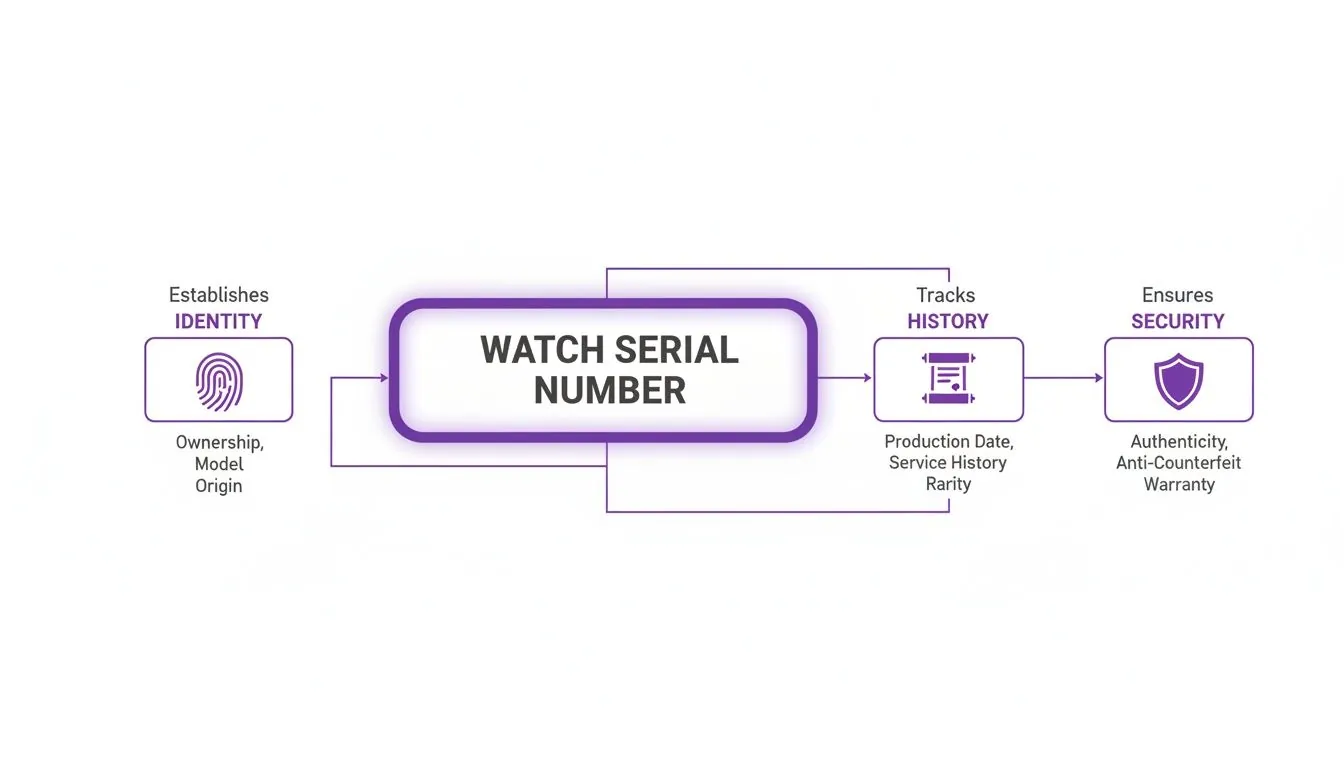 A diagram illustrating how a watch serial number establishes identity, tracks history, and ensures security.
As you can see, these three elements are completely intertwined. A unique identity is what allows for a traceable history, and that history is what provides the security you need for things like authentication or theft recovery.
Common Locations for Watch Serial Numbers
While every watchmaker has their quirks, most serial numbers are found in just a handful of places. Before you start looking, find a well-lit spot and grab a soft cloth to handle your watch. If the engraving is tiny, a jeweler's loupe (a small, powerful magnifying glass) will be your best friend.
Here are the prime locations to check first:
- The Caseback: This is the most common and easiest spot. The serial number is usually engraved right on the back of the watch case, sometimes next to the model number.
- Between the Lugs: A classic placement, especially for brands like Rolex. The lugs are the little "horns" that connect the case to the bracelet. You'll likely need to carefully remove the bracelet to see the engraving, which is typically found on the case at the 6 o'clock side.
- Inside the Movement: For some high-end or vintage watches, the serial number is engraved directly on the intricate internal movement. This is one you should leave to the pros—it requires a watchmaker to safely open the case.
- On the Rehaut: Many newer models (again, think Rolex) have the serial number engraved on the rehaut. That's the inner metal ring that sits between the dial and the crystal. Look closely around the 6 o’clock position; you can see it without taking anything apart.
Finding the Serial Number on Major Brands
To save you some time, here's a quick guide to what you can expect from some of the biggest names in the watch world.
Common Serial Number Locations by Top Watch Brands
This table is a handy cheat sheet for finding the serial number on some of the most popular luxury watch brands.
| Watch Brand | Primary Location | Secondary Location | Notes |
|---|---|---|---|
| Rolex | Rehaut (inner bezel ring) | Between the lugs (6 o'clock) | Pre-2008 models have it between the lugs; modern models have it on the rehaut. |
| Omega | Caseback (exterior) | On the movement | Almost always on the caseback for modern watches. You might find it on a lug for older models. |
| Patek Philippe | Inside the caseback | On the movement | Patek uses two numbers: a case number (inside caseback) and a movement number (on movement). |
| Audemars Piguet | Caseback (exterior) | N/A | Typically engraved clearly on the back of the case. |
| Breitling | Caseback (exterior) | Between the lugs (6 o'clock) | Usually on the caseback, but some models have it between the lugs with the model number. |
| Cartier | Caseback (exterior) | N/A | Clearly engraved on the caseback, often alongside the model number. |
Remember, this is a general guide, and there can always be exceptions, especially with vintage or limited-edition pieces.
Rolex Watches For most Rolex models made before 2005, you'll find the serial number engraved between the lugs at the 6 o'clock position. You have to pop the bracelet off to see it. Starting around 2005, Rolex began adding the serial to the rehaut as well, and by 2008, this became the only spot for it, which is much more convenient. For a more detailed look, you can learn more about the serial number on a watch in our other guide.
Omega Watches Omega keeps things simple. The serial number is almost always engraved right on the exterior of the caseback. On much older, vintage pieces, you might find it on the inside of the caseback or on the movement, but that’s rare for anything modern. It's typically a 7 or 8-digit number.
Patek Philippe Watches Patek Philippe is a bit different, as it uses a two-number system. The movement number is on the movement itself, while the case number is engraved on the inside of the caseback. You need both for proper authentication, and accessing them is a job for a certified watchmaker. These numbers are always listed on the watch’s original Certificate of Origin.
Pro Tip: Before you start hunting around on the watch itself, check your paperwork. The warranty card, certificate of authenticity, or original sales receipt should list the full serial number. This is by far the safest and easiest way to find it.
Your Watch's Story is Etched in its Serial Number
<iframe width="100%" style="aspect-ratio: 16 / 9;" src="https://www.youtube.com/embed/MMFsbRfCaWo" frameborder="0" allow="autoplay; encrypted-media" allowfullscreen></iframe>Think of a watch's serial number as its fingerprint or its DNA. It’s not just a random string of characters; it’s the key that unlocks the entire history of your timepiece. A better analogy might be a car’s Vehicle Identification Number (VIN). Just like a VIN tells you a car's manufacturing details, service history, and ownership records, your watch's serial number connects the dots of its past, present, and future.
This unique identifier is the foundation of provenance—a term collectors use to describe the documented history of an object. For a high-end watch, a solid, verifiable provenance can massively boost its value and desirability. The serial number is where that story begins, creating an unbroken chain from the moment it left the factory to the day it ended up on your wrist.
Unlocking the Past: How to Date Your Watch
For any serious watch enthusiast, one of the coolest things you can do with a serial number is figure out exactly when a watch was made. Brands like Rolex have historically used specific sequences and codes that let experts pinpoint a production year, sometimes even a specific quarter. A Rolex with an "L" serial prefix, for example, tells you it was born in 1989, placing it squarely in a distinct period of the brand's evolution.
This little piece of information is a game-changer for a few reasons:
- Confirming Originality: It helps you verify that the parts on the watch—the dial, hands, bezel—are correct for that specific production run.
- Spotting Rare Gems: Certain serial number ranges belong to transitional models or limited editions, making them far more valuable to collectors.
- Gauging Value: A watch’s age is a huge factor in its price, especially with vintage pieces where some years are more coveted than others.
Knowing the production date helps you understand the true nature of what you own and is your best defense against buying a "Frankenwatch"—a watch cobbled together from a mishmash of unrelated parts.
Authentication, Service, and Keeping it Real
Your watch’s serial number is your first line of defense against fakes and the cornerstone of its long-term care. The very first thing an authorized service center does is log the serial number, creating an official record of any maintenance or repairs.
This service history is crucial. It’s proof that your watch was handled by trained professionals using genuine parts. When you decide to sell, a complete service history tied directly to the watch’s serial number gives the next buyer immense confidence and can easily justify a higher price.
Authenticators also rely heavily on serial numbers, cross-referencing them with brand archives. They scrutinize the engraving style, depth, and placement. A sloppy, shallow, or incorrect serial number is often the quickest giveaway that you’re looking at a counterfeit.
The tight relationship between a case, a movement, and their matching serial numbers is the ultimate proof of a watch's integrity. If a movement's serial doesn't jive with the case serial for that production period, it’s a massive red flag.
A Global Shield Against Theft
The problem of watch theft is real and growing, affecting everyone from individual collectors to major dealers. This is where the serial number transforms from a simple identifier into a critical security feature. According to The Watch Register, there are over 110,000 lost and stolen watches in their database, including pieces from Rolex, Patek Philippe, and Audemars Piguet. Their system flags an average of 5 matches per day in major markets. You can get a better sense of the scale of global stolen watch tracking and why it matters.
This entire global network hinges on serial numbers. When a watch is reported stolen, its serial is flagged. Reputable dealers, auction houses, and pawn shops check these databases before buying any pre-owned watch. This simple check makes it incredibly difficult for thieves to offload stolen goods and dramatically increases the odds of recovery. By knowing and recording your serial number, you're not just protecting your own investment—you're playing a part in securing the entire industry.
Using a Stolen Watch Database to Protect Your Collection
When it comes to protecting your watches from the ever-present threat of theft, being proactive is your best strategy. Think of a stolen watch database as a global neighborhood watch for the entire collector community. These platforms act as a central hub where theft reports are collected, making watch serial numbers instantly searchable for buyers, dealers, and even police departments across the world.
These databases give a watch's serial number a whole new job—it's no longer just an ID, but an active security feature. Before services like these existed, a stolen watch would simply disappear into the murky waters of the secondary market, with almost zero chance of being found. Now, a quick search can immediately red-flag a watch as stolen property, stopping a shady deal right in its tracks.
This creates a serious headache for thieves. When they know a watch's serial number will be broadcast to a network of thousands of collectors and dealers, the piece becomes incredibly difficult to sell and much more likely to be recovered.
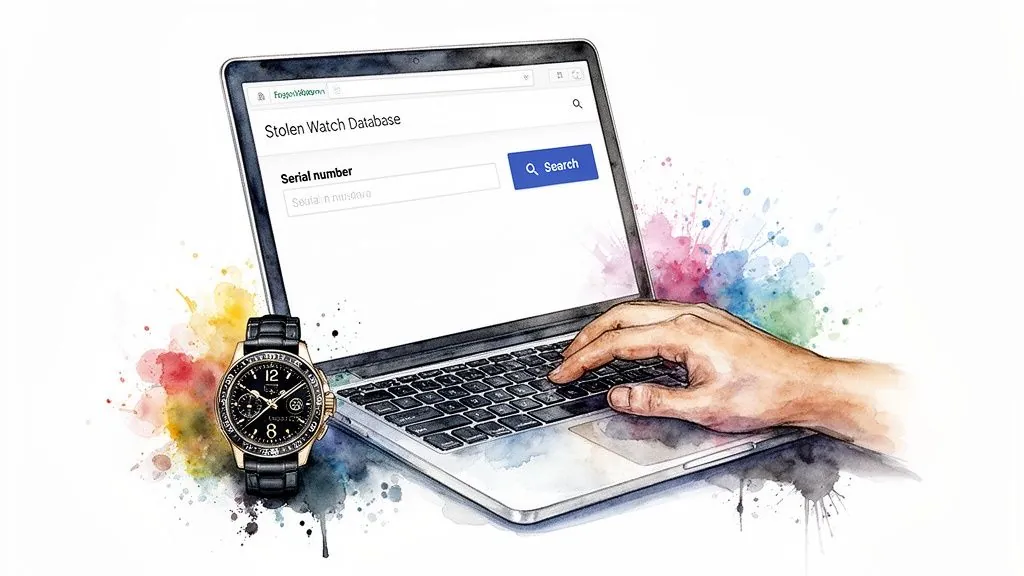 A hand types on a laptop searching a stolen watch database, with a luxury watch nearby.
This screenshot gives you a look at the simple interface of StolenWatch, a service built to make these checks fast and straightforward. The real value of a tool like this is the immediate clarity it provides, giving both buyers and sellers the confidence they need to move forward.
Proactively Registering Your Collection
The single best time to use a stolen watch database is before anything bad happens. By registering your entire collection ahead of time, you create a secure, time-stamped record of ownership that’s ready to be activated at a moment's notice. It’s a simple step that offers incredible peace of mind.
It’s like putting an emergency contact in your phone. You hope you never need it, but if you do, the information is right there, saving you critical time when every second is crucial. If one of your watches is ever stolen, you can instantly flag its serial number, alerting the entire network.
The process is usually as simple as this:
- Create an Account: Sign up on a platform like StolenWatch.
- Enter Watch Details: Add your watch's brand, model, and—most importantly—its unique serial number.
- Upload Documentation: To really solidify your proof of ownership, include photos of the watch, the warranty card displaying the serial, and the original bill of sale.
Once your watch is registered, its details are safely on file. This not only makes reporting a theft faster but also gives you a stronger case when dealing with law enforcement and insurance companies.
How to Check a Serial Number Before You Buy
If you're buying a pre-owned watch, checking its serial number against a stolen watch database isn't just a good idea—it's an absolute must. This is your due diligence. It protects you from the financial hit and legal mess of accidentally buying stolen goods.
All you have to do is type the serial number of the watch you're considering into the database's search bar. Within seconds, the system scans its records. If it comes back clean, you can proceed with confidence. If it gets a hit, you can walk away from a potentially disastrous deal and report the listing to the authorities.
"A quick serial number check is the modern-day equivalent of a handshake agreement backed by data. It fosters transparency and trust, ensuring the secondary market remains a safe place for genuine enthusiasts to transact."
The impact of these databases is real and growing. According to The Watch Register, there has been a massive 236% increase in the number of watches added to its global database in just the last 12 months. Better yet, the system works. On average, four lost and stolen watches are located per day, with 50% recovered within a year and 35% within just six months.
This proves that checking watch serial numbers isn't just a box-ticking exercise; it's a powerful tool that directly helps recover stolen property and disrupts criminal networks. For those focused on particularly sought-after models, our guide on the stolen Rolex watches database offers more specific advice. By making this simple check a standard part of every purchase, you’re helping protect the entire watch community.
What To Do The Moment You Realize Your Watch Is Gone
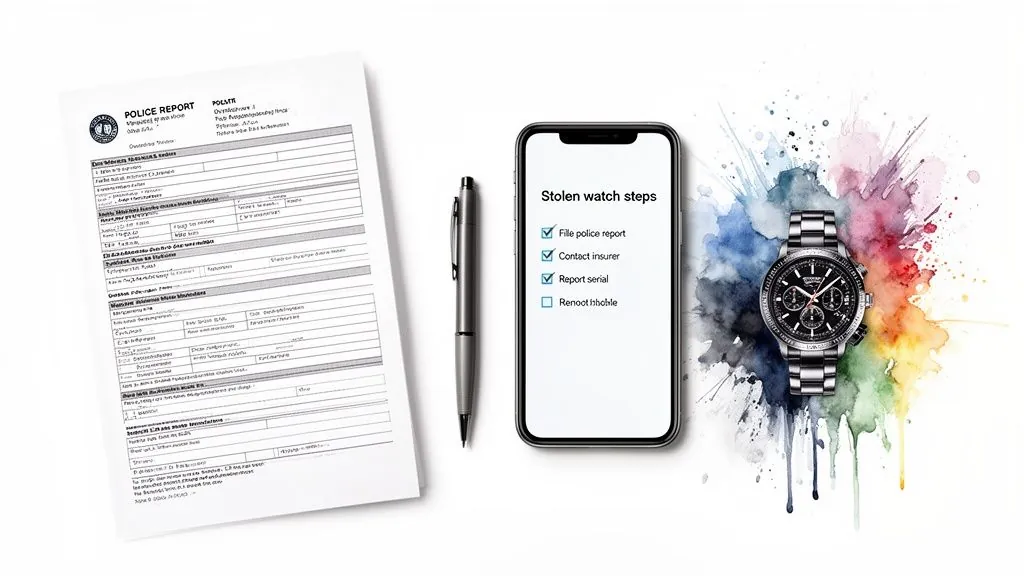 Police report document, pen, smartphone displaying stolen watch reporting steps, and a watch with watercolor art.
The feeling is sickening—that moment of panic when you realize your watch is missing. It's easy to feel helpless, but what you do in the next few hours is absolutely critical. A fast, deliberate response can make all the difference in getting your watch back.
Your very first call should be to the local police. Don't wait. Filing a police report immediately creates an official record of the theft, which is the cornerstone of the entire recovery process. You'll get a case number, and you'll need it for everything that comes next.
Your Three-Step Recovery Checklist
Once you have that police report, it's time to get the word out. The goal is to make your watch too "hot" to handle for any thief or unscrupulous seller. This is where having your watch serial number recorded really pays off.
-
File an Insurance Claim: Get in touch with your insurance company right away. They'll need the police report number, a full description of the watch, its serial number, and any photos you have. Kicking off this process quickly helps avoid delays down the line.
-
Alert the Watch World: This is your most powerful move. You need to register your stolen watch in a global database. Think of it as putting out an APB to the entire watch community—the very people who are most likely to spot it, including dealers, collectors, and pawn shops.
-
Keep an Eye on the Market: Start monitoring online marketplaces like eBay, Chrono24, and even Facebook Marketplace. You can set up alerts for your specific model. If you think you see your watch, do not contact the seller or try to get it back yourself. Pass the information to the police.
When you report a watch as stolen to a central database, its serial number instantly transforms. It goes from being a simple identifier to an active alarm that follows the watch anywhere it goes, making it nearly impossible to sell through any legitimate channel.
Why a Database Report is Your Best Weapon
A thief’s business model depends on a quick and quiet sale. By reporting your watch’s serial number to a service like StolenWatch, you throw a massive wrench in their plans.
Any reputable dealer or pawnbroker will run a serial number check before buying a pre-owned watch as part of their due diligence. If it gets a hit on the database, the deal is dead on arrival. Not only does this stop the sale, but it often leads directly to the recovery of the watch.
This one simple act helps protect the entire community. The more of us who report thefts, the smaller and riskier the marketplace for stolen watches becomes. If you need to report a stolen watch, make sure you have your serial number and police report handy. It’s the single most effective step you can take to bring your timepiece home.
Got Questions About Watch Serial Numbers? We've Got Answers.
When you're dealing with high-value watches, serial numbers can feel a bit mysterious. Whether you're carefully cataloging your own collection or eyeing a pre-owned piece, a few key questions always pop up. Let's clear them up so you can move forward with confidence.
Is a Watch Serial Number the Same as a Reference Number?
That’s a common point of confusion, but no, they are completely different and serve unique jobs.
Here’s a simple analogy: The reference number is like a car's model name, say, a "Honda Civic." It tells you the make, model, and specific configuration, and it applies to thousands of identical cars. The serial number, on the other hand, is the car's VIN—a totally unique identifier for that one specific vehicle.
So, while a Rolex reference like 126610LN points to every 41mm Submariner Date in that production run, the serial number belongs to just one of those watches. This is what makes it the cornerstone of authentication and theft reporting.
What if the Serial Number on My Watch Is Unreadable?
Don't panic—this happens, especially with older watches. Years of wear, particularly on a bracelet, can polish down the engravings between the lugs until they're faint or even illegible.
Your first move is to check your paperwork. The original warranty card, certificate, and even the sales receipt should list the serial number. This documentation is your lifeline.
If you don't have the papers, your next best bet is a professional watchmaker or an authorized dealer. They have the right tools, like loupes and specific lighting, that can often pick up what the naked eye can't. Whatever you do, don't try to clean or polish the area yourself; you could easily make it worse.
Think of it this way: the serial number is your watch's fingerprint. If it's smudged on the watch itself, your documents become the primary DNA evidence proving its identity and your ownership.
Can I Just Call the Manufacturer to Check a Serial Number?
It seems logical, but unfortunately, it's almost always a "no." For very good security and privacy reasons, major brands like Rolex don't offer public databases or phone-in services for consumers to look up serial numbers. Those internal records are kept under lock and key, accessible only to their authorized service centers.
This is precisely why independent, global databases are so essential. They create a public square where the watch community can share vital information that the brands themselves keep private.
Does Registering My Watch Guarantee I'll Get It Back if It's Stolen?
Nothing in life is a 100% guarantee, but registering your watch’s serial number massively tips the scales in your favor.
When you log your watch in a database like StolenWatch, you're essentially putting out a permanent, global APB on that specific timepiece. It makes a thief's job incredibly difficult.
Reputable dealers, diligent pawnbrokers, and smart private buyers make a habit of checking these registries before finalizing a deal. If your serial number pops up as stolen, the transaction hits a dead end. More importantly, it gives law enforcement a crucial lead to follow up on, which is often the key to getting your watch back home.
Brand-Specific Stolen Watch Checks
Check the brand-specific database for your watch:
- Stolen Rolex database
- Stolen Patek Philippe database
- Stolen Cartier database
- Stolen Omega database
- Stolen Audemars Piguet database
Or run a free serial number check against the full database.
Don't wait until it's too late to protect your collection. With StolenWatch, you can securely document your timepieces, run a check on a serial number before you buy, and instantly alert a global network if the worst happens. It’s about building a safer, more transparent community for everyone. Learn more and get started at https://stolenwatchx.com.
Related Articles
View all
Your Definitive Guide to a Movado Serial Lookup
Unlock the secrets of your watch with our guide to a Movado serial lookup. Learn how to verify authenticity, check for theft, and understand your timepiece.
Your Guide to Watches Auctions Online and Spotting Fakes
Master watches auctions online with our expert guide. Learn to spot fakes, verify authenticity, and get the best deals on luxury timepieces.
Watch Serial Number Lookup Results: What a Match or No Record Means
How to read watch serial number lookup results: a stolen match, no record, a near match or a serial that disagrees with the papers, and what to do next.